

Key Takeaways
- EUR/USD has dropped to 1.1460 after hitting highs near 1.1630 last week, pressured by dollar strength and safe-haven flows.
- Support zones to monitor: 1.1460, 1.1420, 1.1370.
- Resistance levels: 1.1495–1.1520 short term, 1.1560–1.1580 mid-channel, 1.1630 key top.
- Neutral with bearish tilt below 1.1495; bullish only if the pair recovers above 1.1520.
- S. and Eurozone PMIs, Fed commentary, and geopolitical risks remain the main catalysts.
- Watch for a break from the 1.1420–1.1520 consolidation zone for directional signals.
Market Dynamics and Recent Performance
The EUR/USD pair has come under renewed pressure, falling to 1.1460 in the early part of the week after hitting highs near 1.1630 just over a week ago. This pullback reflects a combination of persistent U.S. dollar strength, renewed geopolitical fears in the Middle East, and mixed signals from recent Eurozone economic data.
The dollar has regained momentum as investors seek safety amid U.S. military action and expectations of potential retaliation from Iran. This flight to safety has capped the euro’s recent upside, despite its earlier resilience. Meanwhile, the ECB appears to be on pause, and with limited hawkish commentary coming out of Frankfurt, the pair has had little euro-driven upward energy.
The result is a correction-driven, range-bound dynamic—still technically intact within a broader bullish channel, but with a shift toward the lower end of that structure.
Technical and Fundamental Influences
Technical Viewpoint
EUR/USD is currently flirting with key technical levels. After last week’s rise to 1.1632, the pair has retreated sharply, dropping below the 50-period EMA on the 4H chart and testing horizontal support around 1.1460.
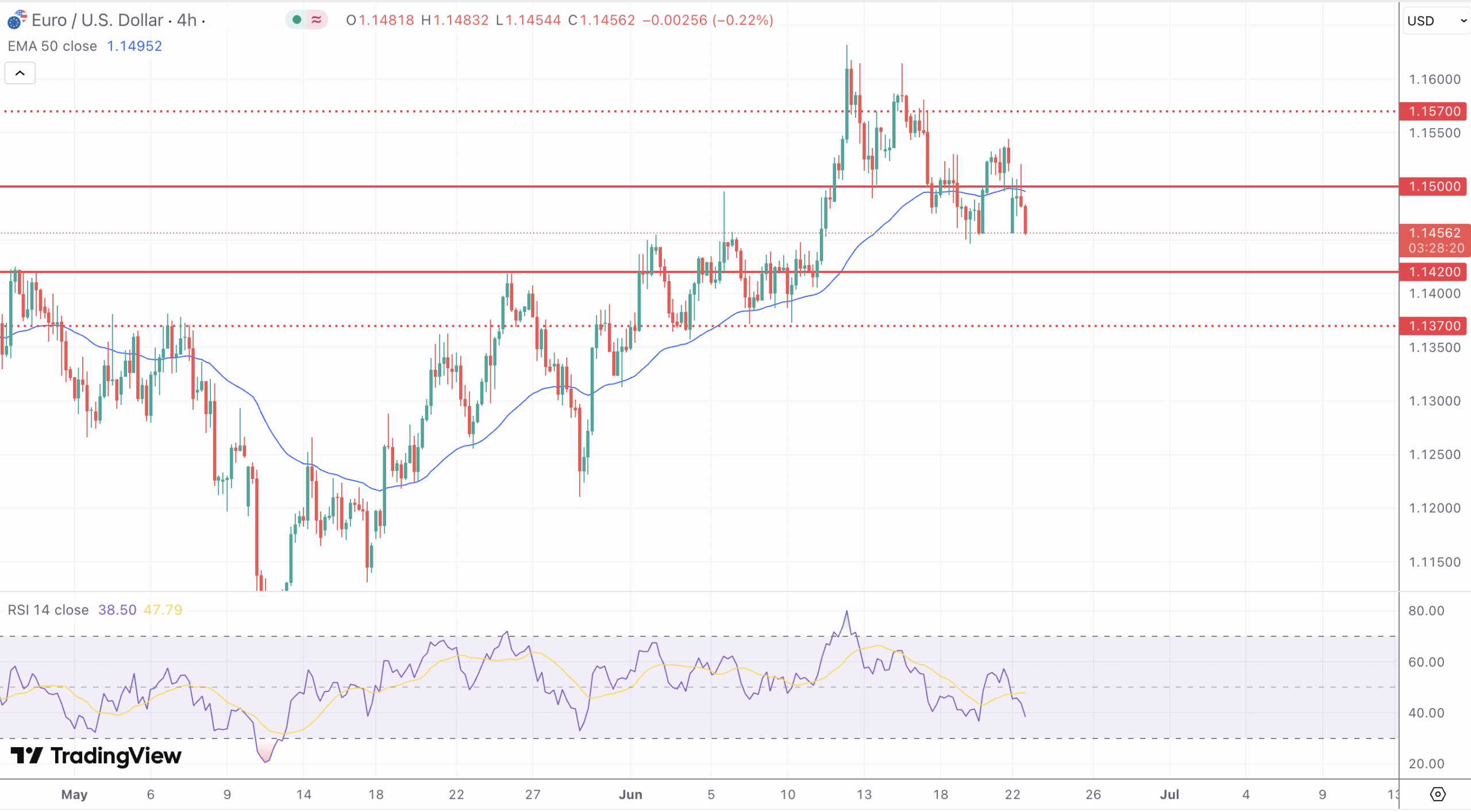
The Relative Strength Index (RSI) on the daily chart has cooled from overbought territory and now sits around the 45–50 zone, suggesting neutral momentum. A deeper move could drive RSI into bearish territory, particularly if the pair breaks below 1.1420.
Here’s how the key technical levels stand:
- Support levels:
- 1460 – current zone, also supported by 100-hour EMA
- 1420–1.1440 – channel base and June mid-level support
- 1370–1.1400 – horizontal support from earlier this month
- 1270 – psychological level and major pivot from May
- 1460 – current zone, also supported by 100-hour EMA
- Resistance levels:
- 1495–1.1520 – immediate hurdle from last Friday’s high
- 1560–1.1580 – mid-channel and prior consolidation range
- 1630 – recent double-top high and a key breakout barrier
- 1495–1.1520 – immediate hurdle from last Friday’s high
A clean break below 1.1420 could trigger accelerated selling toward 1.1370 or even 1.1300. On the flip side, recovery above 1.1520 would restore bullish interest, with further momentum building toward the 1.1580–1.1630 resistance band.
Fundamentals to Watch
The Federal Reserve remains cautious but committed to monitoring inflation. Markets are currently pricing in the possibility of rate cuts starting in September, but Fed officials have hinted they could hold rates higher for longer, especially if energy prices spike due to Middle East disruptions.
The ECB, on the other hand, has softened its stance. Inflation in the Eurozone has cooled, giving policymakers room to remain on hold or even ease later this year. This divergence has kept EUR/USD under pressure, especially with no fresh hawkish rhetoric to support the euro.
This week’s flash PMI data from both sides of the Atlantic will be critical in shaping expectations. Stronger U.S. services or manufacturing prints could lift the dollar further. Meanwhile, any weak Eurozone data may confirm growing divergence between the two economies.
Looking Forward
The euro’s ability to stabilize at current levels will likely depend on two main factors: risk sentiment and the tone of U.S. economic data.
If Middle East tensions ease or if U.S. indicators disappoint, EUR/USD may bounce back toward the 1.1520–1.1580 region. A break of that zone would open a path back to retest the 1.1630 top, though bulls would need strong conviction to push above it, especially without fresh eurozone catalysts.
If dollar strength continues—driven by stronger-than-expected U.S. data, Fed hawkishness, or worsening global risk sentiment—then downside pressure could increase. A break below 1.1420 would likely usher in a deeper corrective phase, with targets around 1.1370 and 1.1300.
As we head into the final week of June, traders should remain nimble. The market is clearly reactive—EUR/USD is at a pivotal zone, and a directional breakout appears increasingly likely.