

Key takeaways
- EUR/USD is trading at approximately 1594, beneath critical support and under pressure from dollar strength
- Technically, the bias remains negative: major moving averages overhead and momentum indicators offer weak bullish confirmation
- A break below 1572 would reinforce downward momentum toward 1.1530 or lower
- Resistance lies in the 1620–1.1650 zone, with a stronger barrier at 1.1682
- Trade approach: favor short or neutral exposure unless a clean breakout occurs; use tight risk control and monitor macro catalysts
Market Dynamics and Recent Performance
EUR/USD has resumed under pressure after failing to hold critical support around 1.1600. The broader U.S. dollar strength—fueled by resilient economic data and hawkish leanings from U.S. policymakers—has weighed heavily on the cross. Meanwhile, the euro’s internal challenges—slow growth, political jitters in key members, and cautious tone from the ECB—are contributing to limited upside conviction.
In intraday action, EUR/USD has been oscillating around the 1.1570–1.1625 band, with downward probes dominating and any uptick facing resistance near the mid-range levels. A break below the 1.1580 area triggered stop-loss clusters, which added downward momentum, whereas attempts to rally have met fresh selling interest near 1.1620–1.1650.
Technical and Fundamental Influences
From a technical framework, the trend is biased toward the downside unless proven otherwise. The current rate sits below key moving averages (20, 50, 100 SMAs/EMAs) which are acting as overhead resistance barriers.
Momentum indicators, like RSI and MACD, lean bearish or neutral, signaling that bullish attempts may lack conviction. Technical analysts suggest that a break below 1.1572 would intensify bearish bias in the short term.
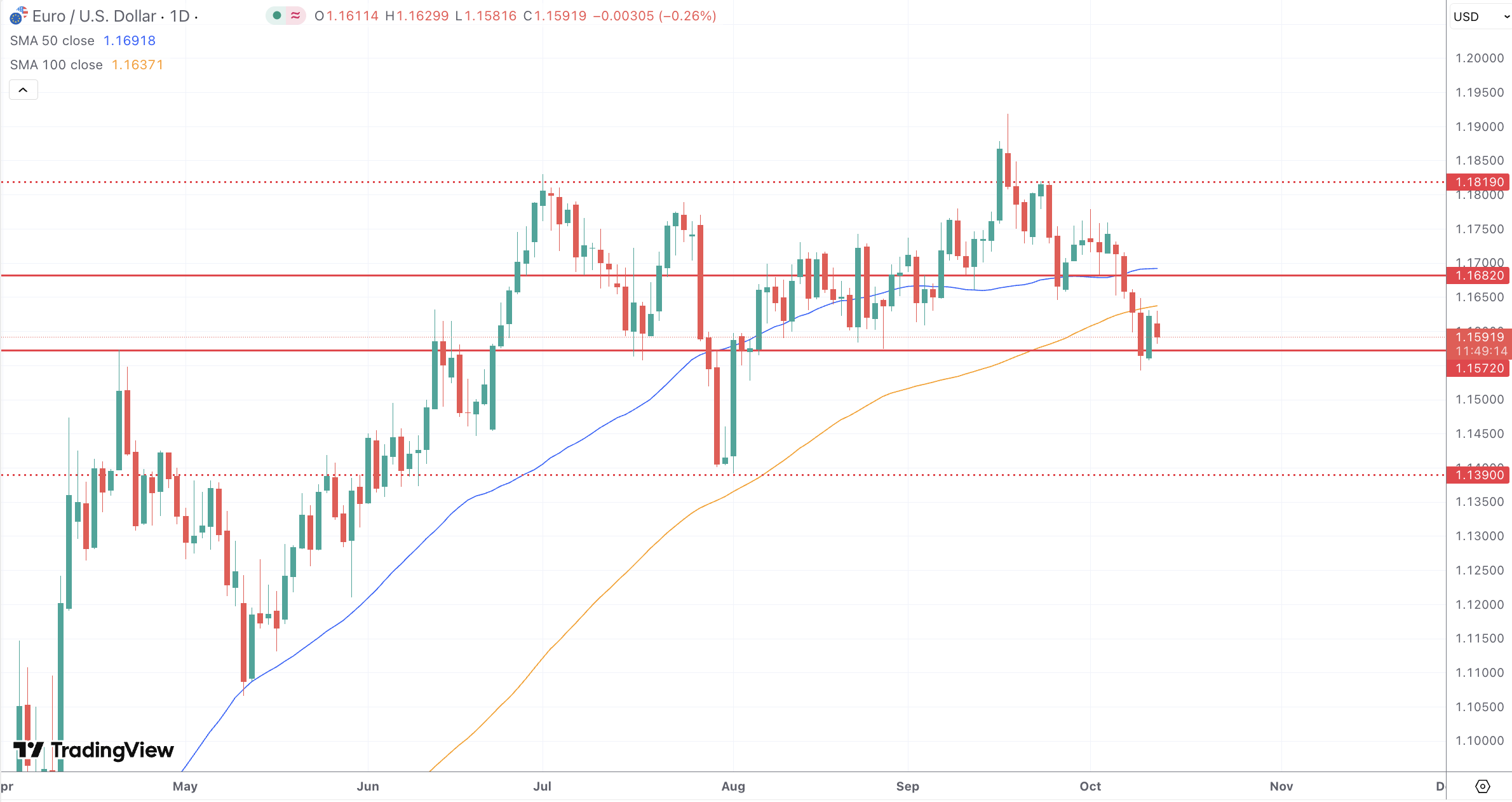
On the upside, crossing above 1.1682 is cited as a threshold to shift intraday bias from negative to neutral. In the bigger picture, the drop from highs around 1.1917 is regarded by some as a multi-leg decline in progress, with support zones near 1.1390 and even 1.1252 considered as potential targets if momentum fully turns bearish.
Fundamental drivers also support a cautious-to-bearish tilt. The U.S. economy has shown resilience in inflation and labor indicators, pushing markets to keep a skeptical eye on aggressive Fed easing. This dynamic strengthens the dollar against the euro, whose economy is stagnating in key sectors like industry and exports. Political uncertainty in major eurozone states also adds risk premium to EUR. That said, options flows have indicated a continued preference toward USD puts over the longer run, pointing to some latent expectation of dollar softness over time. However, in the near term, the dominant force likely remains dollar firmness.
Looking Forward
Given the starting point at 1.1594, the path of least resistance leans downward unless a catalyst intervenes. If the euro manages to muster strength—e.g. weaker-than-expected U.S. data or dovish signals from the Fed—it could try to reclaim 1.1620–1.1650. But it needs a clean break above 1.1682 for that scenario to gain credibility. On the downside, a breach below 1.1572 may open the door toward 1.1530 and, in extension, toward 1.1480 or 1.1450 or lower if selling accelerates.
Traders holding long should be cautious of resistance zones and treat them as potential reversal areas, while shorts should guard for oversold conditions and possible relief bounces. Volatility is likely to remain elevated, especially around U.S. macro releases (CPI, PCE, nonfarm payrolls) and ECB commentary. Intra-week ranges may stretch between about 1.1540 and 1.1660, barring a strong directional surprise.