

Key Takeaways
- EUR-USD trades at 1.16 within a well-defined 1.1550-1.1650 range, struggling to break above resistance amid renewed dollar strength and Fed uncertainty.
- Federal Reserve rate cut probability for December has fallen to 53% from 64%, with hawkish official commentary capping euro upside potential.
- RSI at 49.6 and MACD at 0.000 indicate neutral conditions with no directional bias, leaving the pair vulnerable to external catalysts from central bank speakers.
- Key levels: Support at 1.1560-1.1545 and 1.1530-1.1550; Resistance at 1.1625-1.1650 and 1.1680-1.1700. Break above 1.1700 targets 1.1730-1.1760.
- ECB President Lagarde maintains “good place” rhetoric with markets pricing only 13 basis points of cuts through end-2026, signaling easing cycle completion.
- Multiple Fed speakers this week will provide crucial guidance on December meeting expectations, with ISM PMIs and ADP employment data offering additional catalysts.
The euro trades at 1.16 against the dollar this week, maintaining its position within a well-defined range as traders assess the policy trajectory of both the Federal Reserve and European Central Bank. The pair faces critical tests ahead as central bank rhetoric and economic data releases shape near-term direction.
Market Dynamics and Recent Performance
EUR-USD continues to consolidate between 1.1550 and 1.1650 after retreating from October highs near 1.1778. The pair’s inability to sustain momentum above 1.1630 reflects renewed dollar strength and uncertainty surrounding the December Fed meeting. Recent price action has been characterized by shallow pullbacks and narrow trading ranges, with the 1.1600 level emerging as a psychological anchor for short-term flows.
The dollar found support following hawkish commentary from Federal Reserve officials, with market pricing for a December rate cut declining from 64% to approximately 53%. This shift in expectations has capped euro advances despite relatively stable Eurozone economic conditions. ECB President Christine Lagarde’s assertion that policy is “in a good place” has reinforced expectations that the central bank’s easing cycle has effectively concluded, with markets pricing only 13 basis points of cuts through end-2026.
Trading volumes remain elevated as institutional players position for year-end, though the extended US government shutdown has created uncertainty around data flows. The resumption of economic releases following the 43-day closure will provide crucial insight into labor market conditions and inflation trends, potentially shifting Fed expectations. The pair has demonstrated resilience above the 1.1550 support zone despite multiple tests, suggesting underlying demand persists at lower levels.
Technical and Fundamental Influences
The 14-day Relative Strength Index sits at 49.6, indicating neutral conditions with no directional bias. This reading suggests the pair has room to move in either direction depending on upcoming catalysts. The MACD indicator shows neutral positioning at 0.000, confirming the lack of strong momentum in either direction. Price action remains anchored near both the 5-day moving average at 1.1618 and the 50-day moving average at 1.1620, highlighting the current equilibrium state.
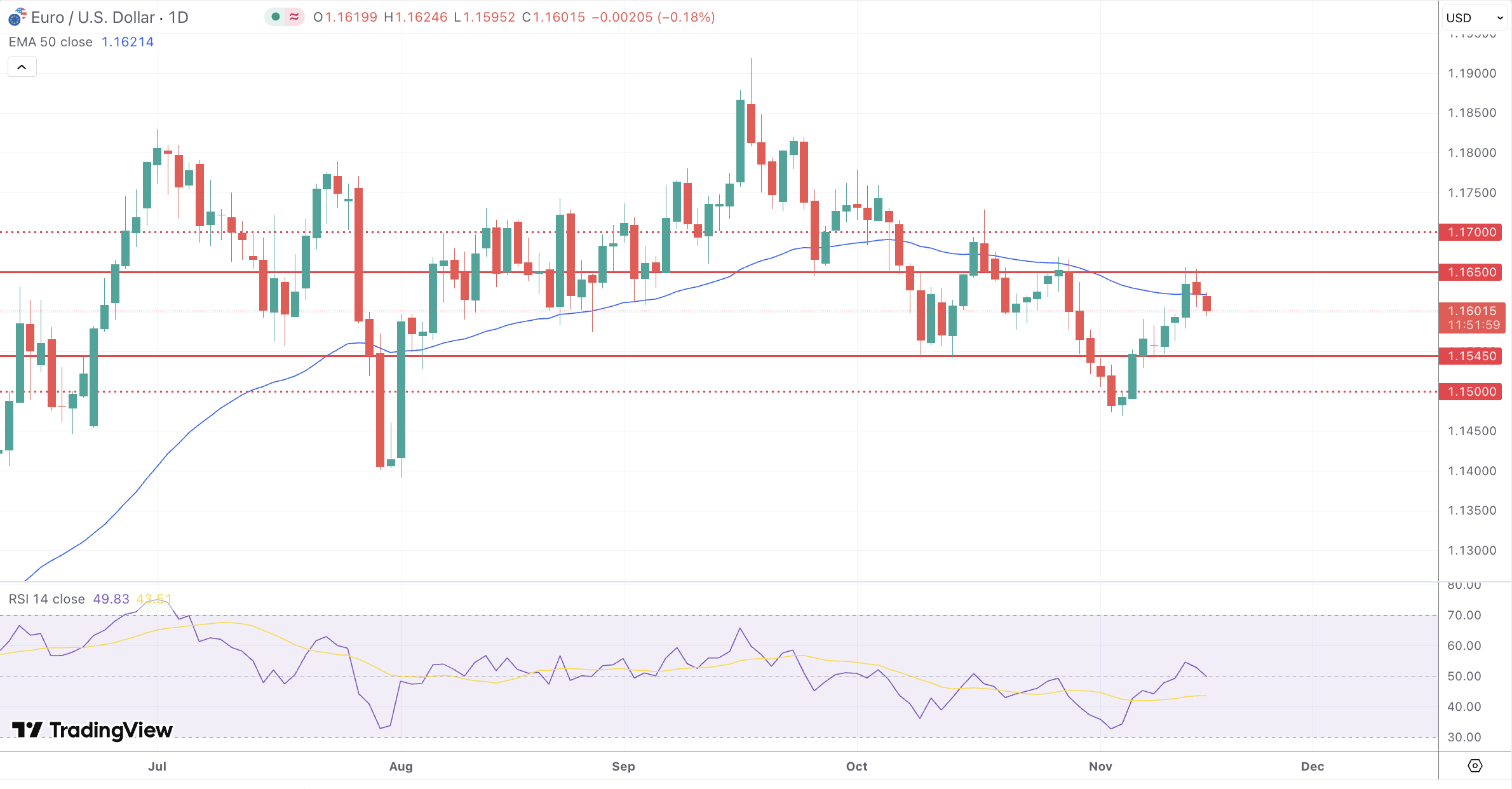
Resistance levels have crystallized around several key zones. Immediate overhead barriers sit at 1.1625-1.1650, where the 100-day simple moving average intersects with prior consolidation levels. Beyond this zone, the 1.1680-1.1700 area stands as significant resistance, where the 200-period simple moving average and Fibonacci 38.2% retracement converge. A decisive break above 1.1700 would target the 1.1730-1.1760 zone and potentially the October highs near 1.1778.
Support structures are equally well-defined. The 1.1560-1.1545 zone provides the first layer of defense, marked by recent intraday lows and technical support. Below this area, the critical 1.1530-1.1550 region represents the base of recent trading activity and coincides with the October lows. A breakdown beneath 1.1530 would expose the pair to further losses toward 1.1500 and potentially 1.1440, where longer-term support from August resides.
The fundamental backdrop centers on diverging central bank policies and relative economic performance. The Federal Reserve remains data-dependent but increasingly cautious about additional easing, with several officials highlighting persistent inflation concerns. Kansas City Fed President Jeffrey Schmid’s comments that inflation remains “too hot” exemplify the hawkish camp’s influence. Conversely, ECB officials appear satisfied with current policy settings, viewing the 2.00% deposit rate as appropriately calibrated to guide inflation toward target without stifling growth.
Eurozone economic data has shown surprising resilience, with GDP figures exceeding expectations and business confidence stabilizing. Germany’s IFO Business Climate index improved modestly in October, suggesting the region’s largest economy may be finding its footing after prolonged weakness. This relative stability contrasts with US economic uncertainty stemming from the government shutdown and mixed labor market signals.
Interest rate differentials continue driving flows, with the 2-year EUR-USD swap rate differential remaining a key metric for traders. The narrowing gap between Fed and ECB rates has provided periodic support for the euro, though the dollar’s safe-haven status during risk-off episodes limits sustained euro rallies. Political developments in Germany and France add a layer of uncertainty, though markets have largely absorbed these concerns.
Looking Forward
The week ahead brings multiple Fed speakers whose remarks could significantly influence dollar trajectory. Any shift toward a more dovish stance would likely benefit EUR-USD, while reinforcement of hawkish views could pressure the pair lower. ECB President Lagarde is scheduled to speak early in the week, though her comments are expected to maintain the recent “good place” narrative without signaling policy changes.
Economic data releases remain limited due to the shutdown’s lingering effects, but private sector indicators will offer clues about economic momentum. The ISM manufacturing PMI on Monday and services PMI on Wednesday will be closely watched, as will the ADP employment report. Strong readings would support the dollar by validating the Fed’s cautious approach, while weakness could revive rate cut expectations and boost the euro.
From a technical perspective, the pair’s fate hinges on its ability to hold the 1.1550 support zone. Bulls remain in control as long as this level holds, with any dips likely attracting buyers seeking value. A clean break above 1.1625-1.1650 would confirm short-term upside momentum and target the 1.1680-1.1730 range. This scenario would require either dovish Fed rhetoric or unexpectedly weak US data.
Conversely, failure to defend 1.1550 would signal a shift in sentiment and open the door to 1.1500. A breakdown below this psychological level could accelerate selling toward 1.1440-1.1450, where longer-term buyers may emerge. This bearish scenario would likely require hawkish Fed guidance or significant dollar strength driven by safe-haven flows.
Seasonal factors suggest December has historically been a weak month for the dollar, with the DXY index averaging declines of 0.56% since 2010. If this pattern holds, it could provide modest tailwinds for EUR-USD into year-end. However, traders should remain cautious about relying solely on seasonal tendencies given the current policy uncertainty.
The most likely outcome for this week remains range-bound trading between 1.1550 and 1.1650, with the pair oscillating around the 1.16 handle in the absence of major catalysts. Positioning ahead of year-end and the lack of clear directional signals from central banks supports this consolidation view.