

Key takeaways
- BTC is consolidating around $115,000, which now acts as a critical pivot area
- Overhead resistance lies near $115,800–$116,200; a breakout there points toward $118,000+
- On the downside, a break below $115,000 could expose support in $112,000–$110,000
- On-chain and participation metrics (wallet counts, profit % of supply) remain healthy but not infallible signals
- The next directional move will likely be triggered by macro cues (Fed, inflation, regulation), so keep an eye on those
Market Dynamics and Recent Performance
Bitcoin’s positioning near $115,000 has created a zone of intense scrutiny. After an extended rally, the market is now in a phase of consolidation, where every dip and bounce is tested for durability. As BTC hovers at this level, traders appear to be at a crossroads—do they press for further gains or step back for a deeper rest? The broader macro environment plays an outsized role here: U.S. monetary policy expectations, inflation data, regulatory updates, and institutional flows remain the key market drivers.
Bitcoin’s recent inability to decisively sustain levels above $115,000 suggests resistance is mounting, even as bulls defend the zone as potential support.
Technical and Fundamental Influences
From a technical perspective, $115,000 is acting as a pivotal pivot. The market is forming a relatively tight range, with overhead resistance around $115,800–$116,200. A clean breakout above that band with conviction would favor extension toward $118,000 and possibly $120,000+ territory.
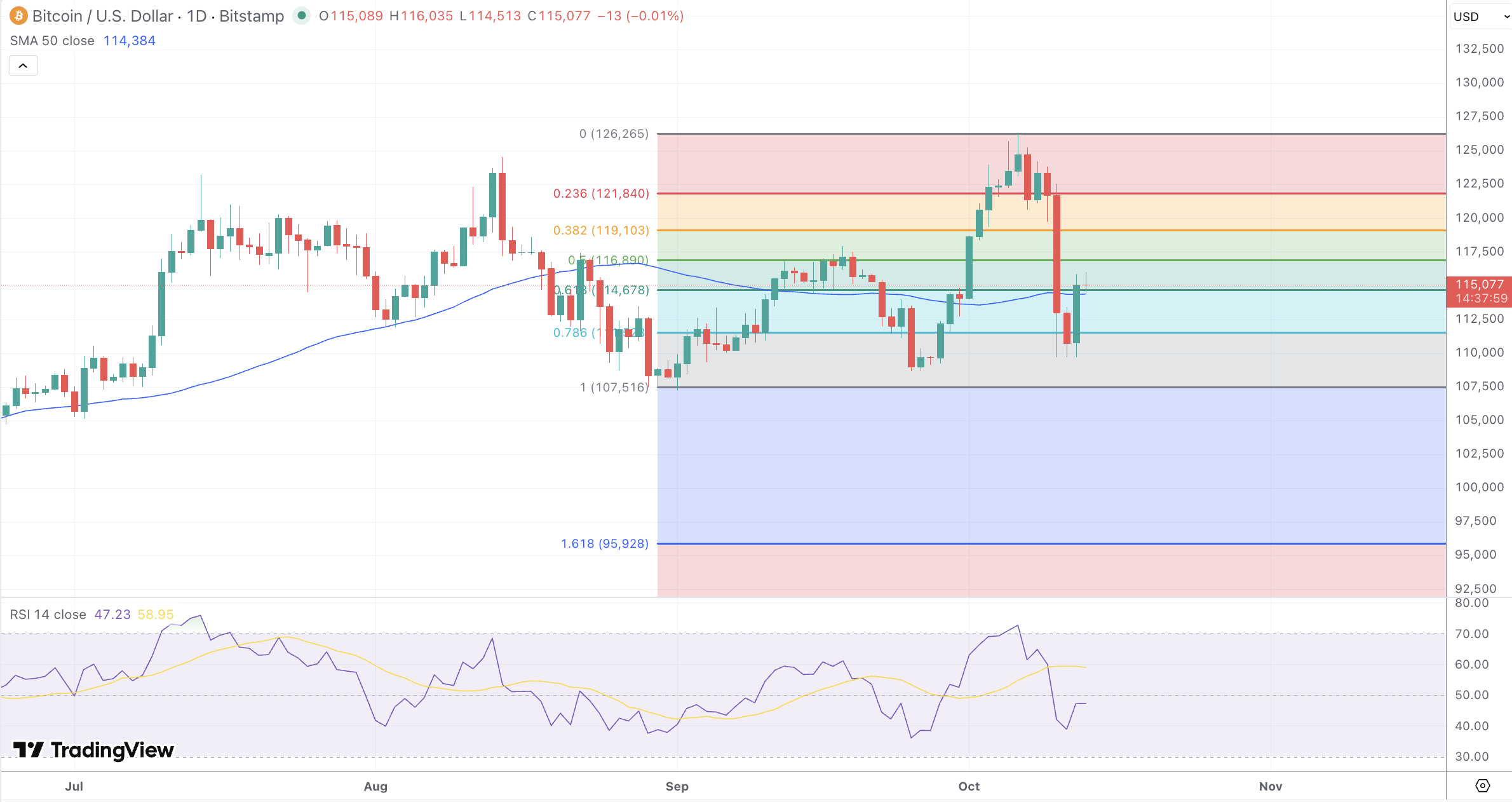
On the downside, failure to hold $115,000 could invite a retest of support in the $112,000–$110,000 region. Some analysts point out that a futures gap exists just below the $115,000 mark (e.g. between $114,380 and $115,630) which historically tends to be “filled” in subsequent price action. Whale profit-taking also presents a known downside risk, especially when the market becomes overbought and participants scale back exposure.
On-chain metrics strengthen the bullish view in some respects: the number of wallet addresses holding nonzero balances has edged higher, indicating broad participation is rising. Also, over 90 % of the circulating BTC supply is reportedly in profit, which is often seen in strong trends (though it can also flag exhaustion risk). That said, open interest in derivatives markets has surged even as spot volumes have stagnated—this divergence suggests leveraged positioning is playing a big role in current price behavior.
Fundamentally, BTC’s trajectory depends heavily on external catalysts. The Fed’s actions and messaging remain paramount—factors like whether rate cuts arrive earlier, inflation surprises, or hawkish surprises can push BTC either way. Further institutional inflows into ETFs or accumulation by large players could reinforce momentum. Conversely, regulatory crackdowns or negative policy statements could introduce sharp reversals. The consolidation at $115,000 suggests market participants are waiting for a clear macro cue to resolve directionality.
Looking Forward
With $115,000 as the present battleground, the coming days are likely to be defined by oscillation unless a catalyst provokes a breakout. If bulls succeed in pushing and holding price above $115,800–$116,200, the path toward $118,000 and potentially $120,000 becomes plausible. Momentum traders may try to chase that breakout, but must watch for fakeouts. If bulls falter and the price slips below $115,000 decisively, the retreat may accelerate toward $112,000–$110,000 and test the broader support zone. In that scenario, traders should watch for signs of stabilization before reloading.
Risk control is essential—tight stops just below $115,000 for longs, and above $116,200 for shorts, could help manage the likely volatility. Given the compressed range, intraday breakout fades may also provide opportunities. Overall, until one side clearly wins out, BTC may grind within a band between $112,000 and $116,500.