

Key Takeaways
- Current Price Action: EUR/USD consolidates near 1.1674, down 1.8% over the past month, testing critical support at 1.1650 where the 100-day SMA and bullish trendline converge
- Technical Levels: Immediate support at 1.1650, 1.1580, and 1.1550; resistance at 1.1700, 1.1725, and 1.1760; descending triangle pattern suggests potential for further downside
- Central Bank Policy: Fed projects additional 50 basis points of cuts by year-end with meeting October 28-29; ECB holds at 2.00% with rate-cutting cycle potentially complete
- Trade Tensions: Trump’s 100% tariff threat on China by November 1 creates uncertainty despite recent de-escalation rhetoric; planned Trump-Xi meeting remains uncertain
- French Politics: PM Lecornu survived no-confidence votes but political instability persists; pension reform suspension until 2028 raises fiscal concerns
- Week Ahead: October 24 US CPI report is primary catalyst; Fed Chair Powell and ECB President Lagarde speak at IMF meetings; government shutdown continues limiting data flow
- Trading Strategy: Range-bound approach favored; buy 1.1550-1.1600 support, sell 1.1700-1.1760 resistance; breakout below 1.1620 targets 1.1550, while move above 1.1700 eyes 1.1750
- Outlook: Consolidation likely continues through month-end within 1.15-1.17 range; significant breakout probable around Fed/ECB meetings October 28-30
The EUR/USD pair trades near 1.1674 as of October 20, showing modest gains of 0.17% in Monday’s session. However, the pair faces mounting headwinds as geopolitical tensions resurface and central bank policies continue to diverge. The coming week promises significant volatility as traders position themselves ahead of critical economic events and ongoing political uncertainty on both sides of the Atlantic.
Market Dynamics and Recent Performance
The single currency has experienced considerable pressure throughout October, declining approximately 1.8% from its recent peaks. After briefly touching 1.1900 in mid-September following the Federal Reserve’s anticipated rate cut, EUR/USD has retreated to test critical support zones between 1.1550 and 1.1700. Trading patterns reveal a descending triangle formation on shorter timeframes, with lower highs converging toward a flat support base around 1.1650, suggesting potential for further downside if key levels fail to hold.
French political turmoil continues to weigh on the euro. Prime Minister Sébastien Lecornu narrowly survived dual no-confidence votes on October 16, providing temporary relief, though the underlying crisis persists with France’s divided parliament and 6% GDP budget deficit. The US government shutdown, now in its third week, has created an unusual data vacuum that ironically provides some dollar support. The Bureau of Labor Statistics will release the October CPI report on Friday, October 24, which could inject significant volatility into currency markets.
Technical and Fundamental Influences
From a technical perspective, EUR/USD finds itself at a critical juncture. The 100-day Simple Moving Average currently sits at 1.1650, providing immediate support alongside the May-August bullish trendline. A sustained break below this confluence would expose the pair to deeper losses, with subsequent support levels identified at 1.1580 (Fibonacci 61.8% retracement), 1.1550, 1.1500, and the psychologically important 1.1460 handle.
On the upside, resistance clusters between 1.1700 and 1.1725, where the 20-day, 50-day, and 200-period exponential moving averages converge on the four-hour chart. The 21-day EMA intersects with a short-term bearish trendline near 1.1725, creating a formidable barrier for bulls. Only a decisive clearance above 1.1760 would signal renewed bullish momentum and potentially open the path toward 1.1800 and beyond.
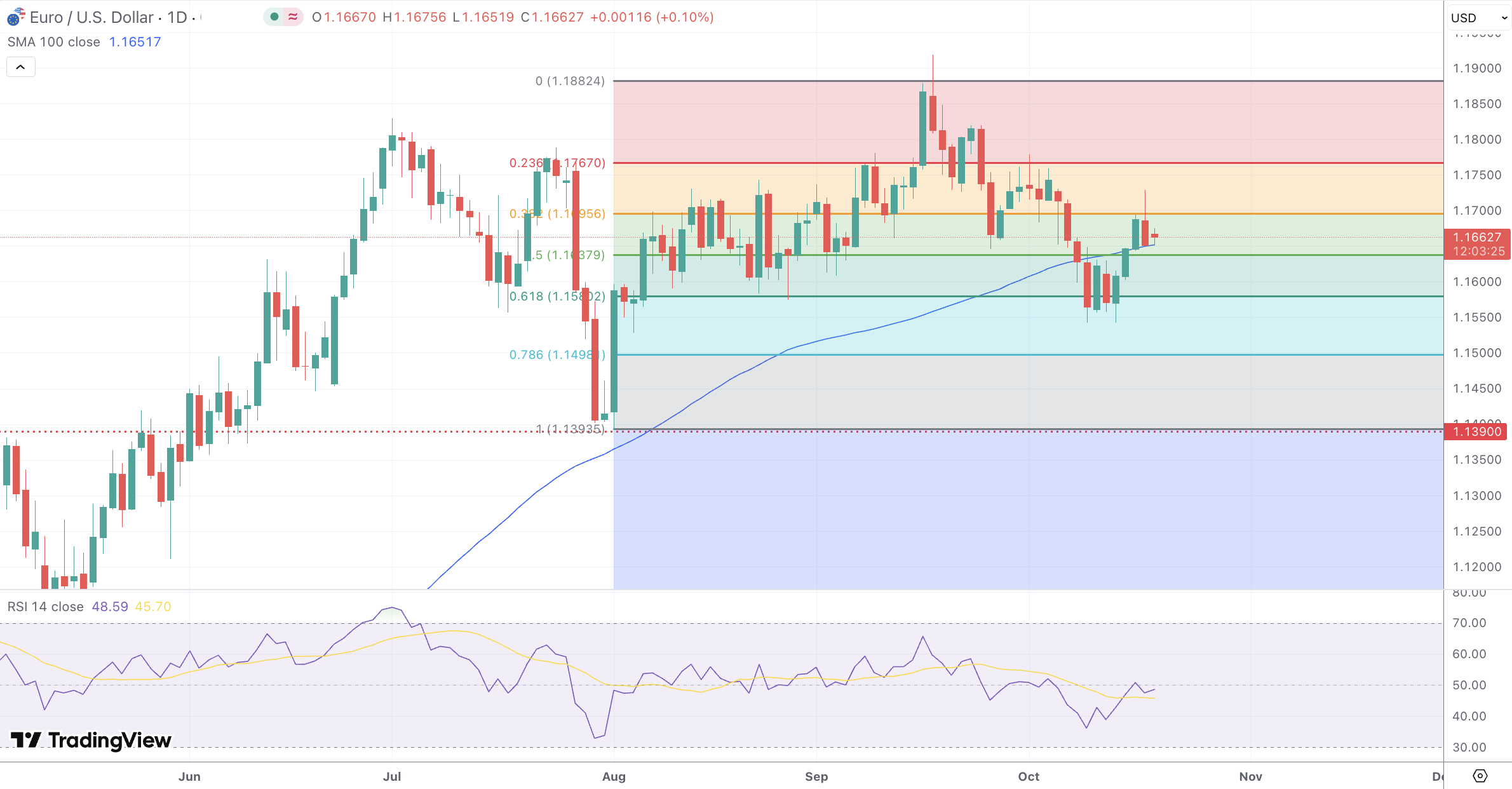
The Relative Strength Index has climbed from oversold territory but remains below neutral 50, indicating that while immediate downside pressure has eased, bullish conviction remains weak. The Stochastic oscillator shows similar characteristics, rising from oversold levels but with substantial room to climb before reaching overbought conditions. These momentum indicators suggest any near-term rallies may prove corrective rather than impulsive.
Fundamental drivers present a mixed picture. The Federal Reserve cut rates by 25 basis points at its September meeting, bringing the federal funds rate to 4.00-4.25%. The FOMC’s updated dot plot projects an additional 50 basis points of cuts through year-end, with another 25 basis points anticipated at the October 28-29 meeting. However, persistent inflation readings around 2.9% and a resilient labor market give the Fed latitude to proceed cautiously.
The European Central Bank, by contrast, has held its deposit facility rate steady at 2.00% since June. ECB President Christine Lagarde signaled the rate-cutting cycle may be nearing completion as eurozone inflation hovers around the 2% target. September inflation registered 2.2%, slightly elevated from August’s 2.0%, driven by services and energy components. Growth projections were revised upward to 1.2% for 2025, providing the ECB with confidence to maintain its current stance.
This policy divergence theoretically favors euro strength, yet the currency has struggled to capitalize. The discrepancy highlights that interest rate differentials alone cannot determine exchange rate movements when geopolitical risks and fiscal concerns dominate sentiment.
Looking Forward
The week ahead carries substantial event risk, led by escalating US-China trade tensions. President Trump’s threat to impose 100% tariffs on Chinese goods by November 1 creates uncertainty, though he later characterized these levels as “not sustainable.” The scheduled Trump-Xi meeting at the Asia-Pacific Economic Cooperation summit remains in question. The upcoming CPI report on October 24 represents the week’s primary data catalyst, with consensus expecting 0.3% month-on-month core inflation. Fed Chair Powell and ECB President Lagarde address the IMF autumn meetings, potentially shaping near-term positioning.
The technical setup favors range-bound trading with a slight bearish bias. A close below 1.1620 would confirm bearish momentum targeting 1.1580 and 1.1550, while recovery above 1.1700 could trigger short covering toward 1.1750. Volatility around the Fed and ECB meetings October 28-30 could trigger the next directional breakout.