

Key Takeaways
- Weakening Momentum: EUR/USD trading near 1.1570 with deteriorating technicals showing RSI at 45.53 (below neutral 50) and MACD at 0.00007 with negative divergence forming, indicating sellers gaining control.
- Bearish Technical Setup: RSI below 50 signals bearish bias, while MACD near zero with signal line at -0.00356 suggests momentum fading and potential bearish crossover imminent. Price at 5-day MA (1.1567) with 50-day MA support at 1.1535.
- Resistance Barriers: Immediate resistance at 1.1590-1.1600, then 1.1620, 1.1650, and 1.1680. Critical level at 1.1686 must break to shift momentum bullish and target 1.1700+.
- Support Levels: Key support at 1.1540-1.1550, with critical floor at 1.1500-1.1505. Break below 1.1500 targets 1.1420-1.1440, then 1.1391 (August low).
- Policy Divergence: ECB holding at 2.00% for third straight meeting versus Fed’s active easing (4.00-4.25%), with 66% probability of December cut despite Powell’s caution.
- Eurozone Resilience: Q3 GDP +1.3% year-over-year, inflation stable at 2.2%, allowing ECB patience. Markets price only 45% chance of rate cuts by September 2026.
- US Weakness: Consumer sentiment at 50.3 (3.5-year low), October layoffs +183.1%, August jobs +22,000 support Fed easing case despite government data blackout.
- Shutdown Impact: Historic US government closure creates data vacuum complicating Fed decisions. Resolution could trigger volatility as delayed releases force market reassessment.
- Trading Strategy: Watch 1.1540-1.1550 support for breakdown risk; short-term bias favors downside testing 1.1500. Resistance trades at 1.1590-1.1600. CPI Thursday is key catalyst.
- Outlook Probabilities: Base case (50%) sees test of 1.1500-1.1520 support with consolidation. Bearish scenario (30%) targets 1.1420-1.1440 on sub-1.1500 break. Bullish case (20%) needs break above 1.1600 to reach 1.1650-1.1680.
Market Dynamics and Recent Performance
The euro trades near 1.1570 following a challenging October that saw the pair decline 1.67% despite a narrow 257-pip monthly range. The currency pair closed the previous week with modest gains near 1.1580 but has since slipped toward 1.1570 after testing 1.1468, its lowest level in over three months. While the pair successfully defended support at 1.1542, bulls have struggled to reclaim the 1.1600 psychological barrier, reflecting persistent headwinds from renewed dollar strength and weakening technical momentum.
The euro’s trajectory shifted in mid-October after trading near 1.1730 when the Federal Reserve delivered its October rate cut. Chair Powell’s hawkish commentary regarding December policy uncertainty triggered a sharp reversal, with EUR/USD tumbling through multiple support levels. Current price action around 1.1570 represents a critical juncture where deteriorating technicals meet fundamental policy divergence, creating a range-bound environment between 1.1500 and 1.1700 that has persisted throughout early November.
Technical and Fundamental Influences
Technical indicators paint a bearish picture with the Relative Strength Index at 45.53, falling below the neutral 50 level and indicating sellers have gained control. The MACD reads 0.00007, barely positive but showing negative divergence with the signal line at -0.00356 and histogram at -0.00349, suggesting momentum is deteriorating and a bearish crossover may be imminent. The 5-day moving average at 1.1567 sits at current price levels, while the 50-day moving average at 1.1535 provides support below.
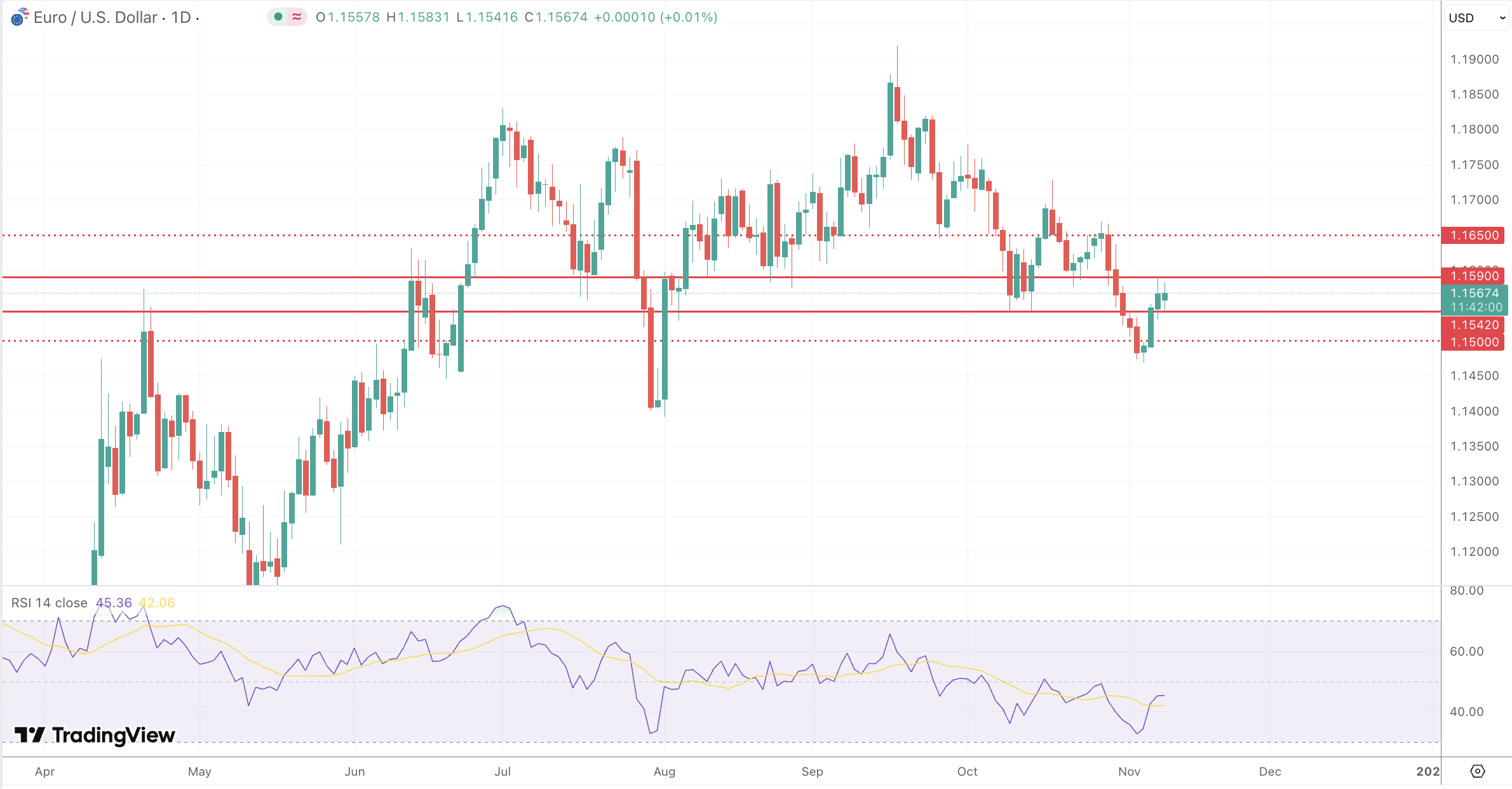
Support levels are clearly defined at 1.1542, followed by 1.1530 and the psychologically significant 1.1500 zone. Resistance stands at 1.1590, then 1.1600, with more substantial barriers at 1.1650 and 1.1680. Fibonacci analysis identifies 1.1686 as a critical resistance level that must be breached to confirm euro strength. Below, the 1.1500-1.1505 zone represents key support, with a breakdown targeting 1.1420-1.1440.
On fundamentals, policy divergence dominates. The ECB held its deposit rate at 2.00% for the third consecutive meeting in October, with President Lagarde stating the bank is “in a good place.” Markets price only 45% probability of rate cuts by September 2026. This contrasts sharply with the Fed’s active easing cycle, delivering quarter-point cuts in September and October to 4.00-4.25%, with 66% probability of another December reduction.
Weakening US data supports Fed easing—22,000 jobs added in August, October corporate layoffs surging 183.1%, and University of Michigan Consumer Sentiment plunging to 50.3. The ongoing US government shutdown creates a data vacuum, complicating monetary decisions. Eurozone fundamentals show resilience with Q3 GDP rising 1.3% year-over-year and inflation anchored at 2.2%, though political uncertainty in France and Germany tempers optimism. Seasonal patterns favor euro strength in December, historically the dollar’s weakest month with average DXY declines of 0.56%.
Looking Forward
Thursday’s US CPI data represents the week’s primary catalyst, with markets scrutinizing whether inflation’s stubborn 3.0% level shows signs of cooling that would justify continued Fed easing. The potential government shutdown resolution adds unpredictability, with Senate measures advancing Monday that could unleash delayed economic data.
With RSI below 50 and MACD showing negative divergence, technical momentum favors downside pressure toward the 1.1540-1.1500 support zone. However, the pair remains range-bound between these levels and 1.1600 resistance, with sellers active above 1.1580 and buyers defending 1.1550.
The base case (50% probability) envisions a test of 1.1500-1.1520 support before potential stabilization, with continued consolidation within 1.1500-1.1600 through mid-November. The bearish scenario (30%) sees a breakdown below 1.1500, targeting 1.1420-1.1440, triggered by strong US data or sustained dollar strength as technical deterioration accelerates. The bullish scenario (20%) requires a decisive break above 1.1600-1.1620, targeting 1.1650-1.1680, but faces headwinds from weakening momentum and needs strong catalysts like weak US inflation or dovish Fed commentary to materialize.