
Key Takeaways
- Current Position: Gold trades around $4,010 after testing all-time highs at $4,381.60, with immediate support at $3,951 and resistance at $4,114
- Technical Outlook: Neutral signals with RSI at 51, MACD showing weakening momentum, and potential bear flag pattern developing on daily charts
- Fed Policy Impact: Recent 25-bp rate cut to 3.75-4.00% range tempered by hawkish guidance, creating uncertainty around December expectations
- Support Levels: Critical supports at $3,951.68, $3,893.96, $3,820, and $3,765-$3,760 cluster
- Resistance Zones: Key barriers at $4,059.90, $4,114.01, and $4,202.40, with psychological $4,000 level acting as pivot
- Trade Relations: Historic US-China agreement reduces safe-haven premium, with tariff cuts to 10% and 30% respectively beginning November 10
- Central Bank Demand: China resumed purchases adding 1.9 tonnes to 2,300-tonne reserves, providing structural price support
- Monthly Forecast: November trading expected between $3,820-$4,344 range, with month-end target around $4,137 representing 3% potential upside
Market Dynamics and Recent Performance
Gold currently trades around $4,010, consolidating near the psychologically significant $4,000 threshold after recording a remarkable 46.59% year-to-date gain. The precious metal achieved an all-time high of $4,381.60 in mid-October before entering a consolidation phase, recording net weekly gains in 31 of 44 trading weeks this year for a 70% success rate.
The immediate trading corridor spans between $3,820 on the downside and $4,114 on the upside. Volume analysis reveals increased institutional participation during this consolidation period, as market participants reassess positions following Federal Reserve policy decisions and evolving US-China trade dynamics. Current price action suggests a range-bound market, with traders determining whether $4,000 will serve as robust support or present resistance.
Technical and Fundamental Influences
Technical indicators present a neutral-to-mixed outlook. The Relative Strength Index currently sits at 51, indicating balanced momentum after retreating from overbought territory above 90 during the peak rally. This neutral RSI positioning suggests room for movement in either direction. The MACD indicator shows declining momentum in the positive zone, confirming waning bullish pressure, while the 20-period Simple Moving Average acts as dynamic resistance near $4,070.
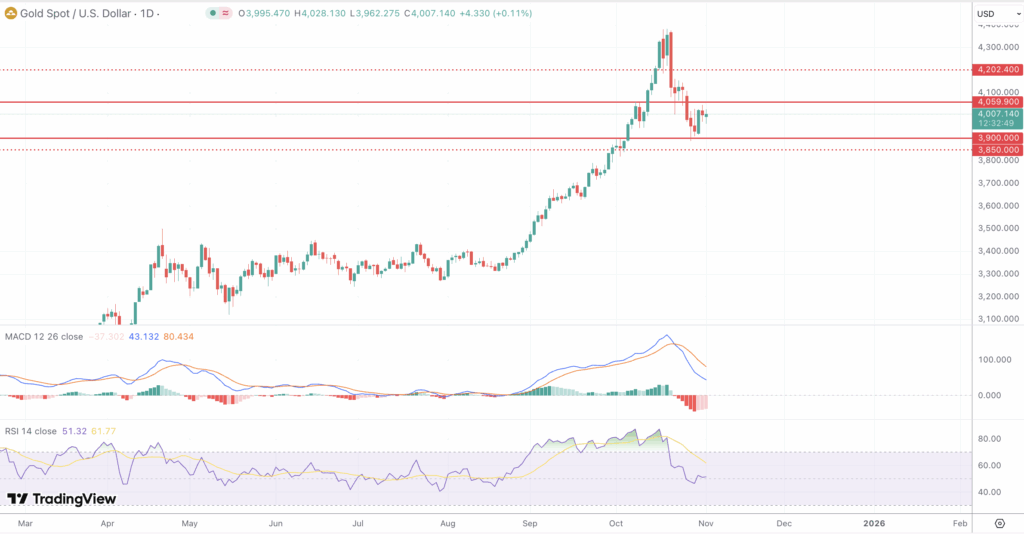
Key resistance levels are established at $4,059.90, $4,114.01, and $4,202.40, with a Bearish Harami pattern at $4,059.90 suggesting potential reversal pressure. Critical support zones include $3,951.68, $3,893.96, and $3,820, with the psychological $3,900 level representing significant buyer interest. A breakdown below $3,886 could accelerate selling toward $3,850-$3,845, with further declines potentially reaching $3,800 and the $3,765-$3,760 cluster. The 23.6% Fibonacci retracement level has found acceptance, though follow-through remains elusive below $4,050.
The Federal Reserve executed a 25-basis-point rate cut in October, lowering rates to 3.75-4.00%. However, Fed Chair Jerome Powell’s hawkish commentary tempered expectations, emphasizing that a December rate cut is “not a foregone conclusion.” This caution injected uncertainty as policy divisions within the FOMC have become apparent amid conflicting signals between slowing employment growth and persistent 2.5% inflation.
Central bank demand continues providing structural support. The People’s Bank of China resumed gold purchases in November after a six-month pause, adding 1.9 tonnes to reach approximately 2,300 tonnes in reserves. This sustained official sector demand from emerging markets establishes a formidable price floor regardless of developed market interest rate policies.
Recent US-China trade developments have reduced safe-haven premiums. President Trump and President Xi Jinping reached a historic agreement beginning November 10, 2025, with China cutting tariffs on US goods to 10% from 125% while the US lowers tariffs to 30% from 145%. China suspended rare earth export controls and committed to purchasing at least 12 million metric tons of US soybeans during the final two months of 2025. This de-escalation temporarily reduces the geopolitical risk premium that propelled gold to record highs.
Looking Forward
The week ahead presents several key catalysts. Forthcoming macroeconomic data releases could shift sentiment rapidly, particularly inflation indicators or labor market reports. Federal Reserve communications toward its December meeting will prove crucial, as any dovish hints could trigger swift rebounds while stronger economic data would extend consolidation or pressure prices lower.
Seasonal patterns favor gold during November-December, as heightened jewellery demand from India and China provides physical market support. ETF holdings have added 638 tonnes in 2025, reaching 3,857 tonnes but remaining below the November 2020 peak of 3,929 tonnes, suggesting room for increased investment demand. Year-end portfolio rebalancing flows could establish additional upward momentum.
Technical patterns suggest a potential bear flag formation, signaling continuation of the corrective move if support fails. However, longer-term structure remains constructive, with monthly indicators displaying 1-month RSI at 95.44 and 1-month ADX at 63.15, confirming an extremely strong underlying uptrend. This creates an environment where dips may present tactical buying opportunities for bullish long-term positions.
Price targets for the coming week suggest continued consolidation between $3,951 and $4,114, with breakout above $4,059.90 on increased volume potentially targeting $4,202.40. Alternative bearish scenarios point to downside objectives at $3,820 should support at $3,951.68 fail. For November, analyst consensus projects trading between $3,820 and $4,344, with month-end target near $4,137, representing modest 3% upside from current levels.
Market participants are pricing in 98.3% probability of a 25-basis-point December cut, though Fed rhetoric suggests this outcome is uncertain. The US dollar, currently near its highest level since early August, exerts inverse pressure on dollar-denominated gold prices, while geopolitical uncertainties including the US government shutdown and unresolved Middle East tensions continue supporting safe-haven appeal.