

Key Takeaways
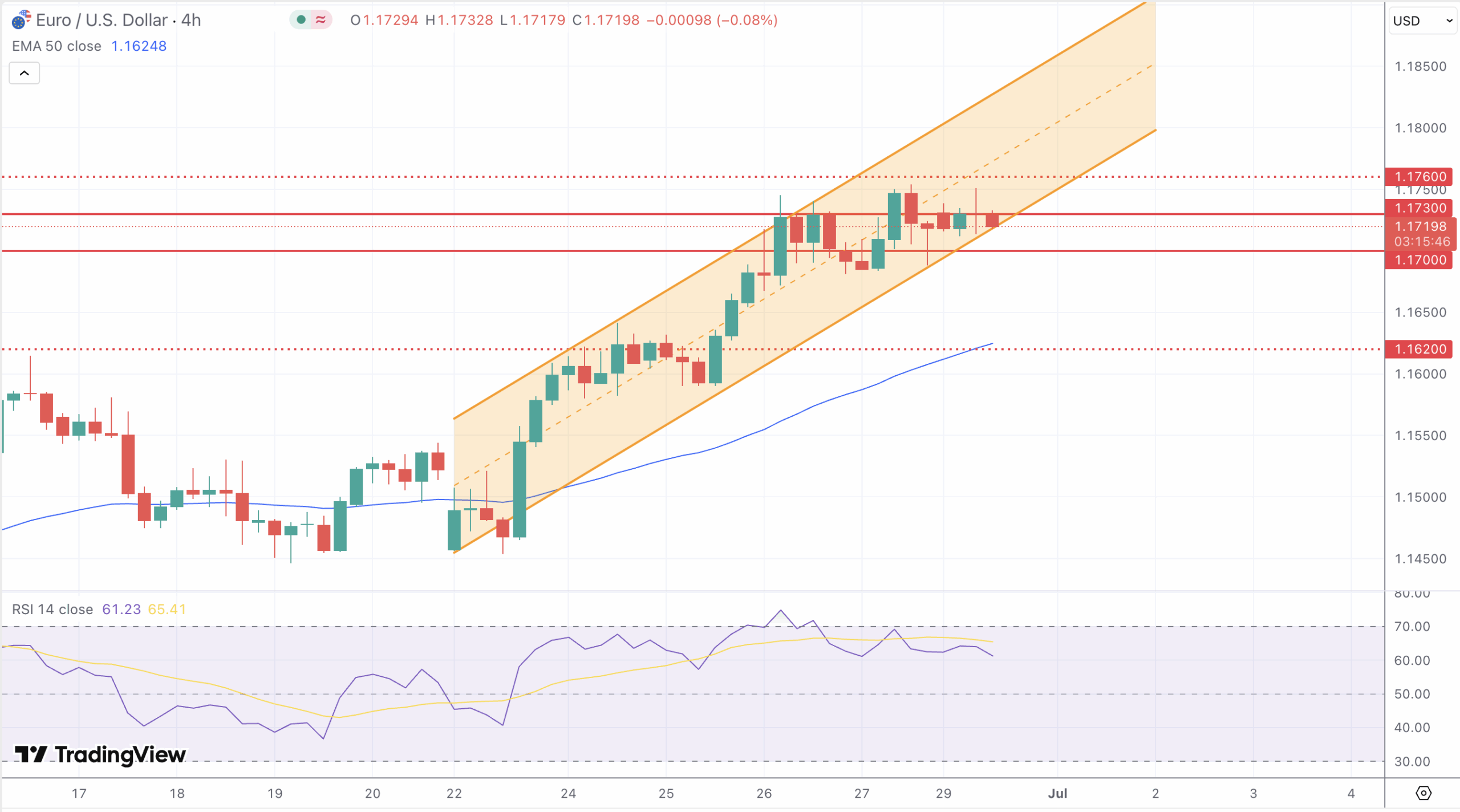
- EUR/USD is trading within a rising channel since June 22, supported by the 50- and 200-period EMAs at 1.1669 and 1.1549.
- Immediate technical barriers lie at 1.1730, 1.1753, and the channel upper limit near 1.1760; supports are clustered at 1.1700, 1.1660, and 1.1620.
- US Dollar weakness—driven by soft spending and income figures and priced-in rate-cut expectations—remains the primary bullish driver for EUR/USD.
- Upcoming German CPI data, US NFP on July 3, and central bank speeches will likely dictate the pair’s near-term trajectory.
- A decisive break above 1.1753 could pave the way toward 1.1782 and 1.1800; failure to hold 1.1700 risks a slide back to the mid-channel support around 1.1660.
Market Dynamics and Recent Performance
EUR/USD began the week consolidating its recent gains, trading just above the 1.1700 mark after surging over 1.5% in the previous week. The rally has been driven by broad-based US dollar weakness—reflected in the US Dollar Index slipping toward 97.00 amid soft US personal spending and income data—and a resurgence of risk appetite following a fragile Middle East truce.
On the Eurozone side, Germany’s retail sales unexpectedly contracted by 1.6% in May, yet the pair held firm as traders looked ahead to preliminary German CPI figures for June and maintained confidence in the common currency.
Technical and Fundamental Influences
From a technical standpoint, EUR/USD is contained within an ascending channel that has been in place since June 22, with price action consistently above both the 50-period EMA at 1.1669 and the 200-period EMA at 1.1549—underscoring the prevailing bullish trend. Short-term momentum indicators further affirm this bias: the 4-hour RSI sits comfortably above 60, while the 20-period simple moving average near 1.1700 now acts as initial support. Key resistance levels align at 1.1730 (static), 1.1753 (recent swing high), and the channel’s upper boundary around 1.1760, with stronger barriers at 1.1782 and 1.1800.
Fundamentally, the prospect of a Federal Reserve rate cut as early as September—priced in by money-market futures—continues to weigh on the dollar, while expectations for a modest uptick in US unemployment (to 4.3%) and a sub-200K print for July’s Nonfarm Payrolls support further EUR/USD strength.
Looking Forward
Market attention now turns to a series of catalysts: Germany’s June CPI release, the European Central Bank’s policy commentary, and the July 3 US Nonfarm Payrolls report. Should German inflation surprise on the upside, it could reinforce the ECB’s hawkish stance, lending fresh momentum to the euro; conversely, below-forecast CPI might temper bullish conviction.
On the US front, a softer NFP outcome than the consensus 110K jobs—combined with rising unemployment—would likely stoke further dollar weakness and keep EUR/USD buoyant. Finally, speeches from ECB Governing Council members and Fed officials later this week will be pivotal: any divergence in messaging on growth or inflation targets could trigger sharp moves within the established channel.