
Key Takeaways
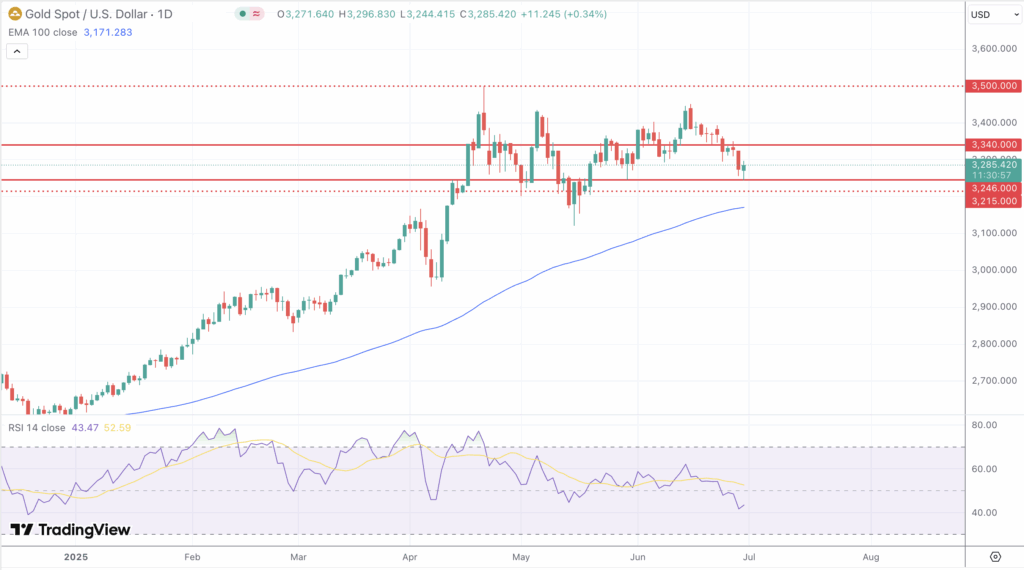
- Gold has oscillated between support at $3,246 and resistance near $3,330–$3,350, guided by moving averages and trendline confluences.
- The RSI’s position below 50 suggests gold is not overbought, leaving scope for a range-bound consolidation.
- Soft US macro data (May personal spending –0.1%, income –0.4%) underpins expectations of Fed rate cuts, maintaining gold’s appeal.
- Speeches by Fed officials this week and the July 9 trade-deal deadline will likely dictate short-term direction.
- A close above $3,330 could open a path toward $3,400–$3,425; failure to hold $3,246 risks a slide to $3,215 and $3,170.
Market Dynamics and Recent Performance
Gold (XAU/USD) opened the week hovering near the $3,288 mark after an initial drift lower in early European trade, before recovering ground mid-week from a one-month trough around $3,246. Improved risk sentiment driven by progress on US–China trade negotiations and a tentative ceasefire between Israel and Iran has weighed on bullion’s safe-haven appeal, prompting traders to trim positions following a more than 5% advance since early June. However, the prospect of earlier and deeper Federal Reserve rate cuts—inferred from a 74% probability of a cut by September priced in by the CME FedWatch tool—has provided an undercurrent of support for the dollar-denominated metal.
Technical and Fundamental Influences
On the technical front, XAU/USD remains anchored above its 100-day exponential moving average at $3,170, signaling a longer-term bullish bias, even as the 14-day relative strength index sits below the 50 midpoint near 41.5—suggesting room for further consolidation or modest pullbacks. Upside barriers cluster around $3,330 and $3,350, corresponding to the 50- and 200-period EMAs at $3,330 and $3,323 respectively, while failure to reclaim these moving averages could expose support at $3,246 and the lower trendline near $3,215.
Fundamentally, US personal spending and income figures for May—down 0.1% and 0.4% respectively—have reinforced expectations of a dovish Fed stance, further undercutting the US Dollar and enhancing gold’s relative attractiveness. Meanwhile, the core personal consumption expenditures price index holding at 2.7% year-on-year adds nuance to the inflation outlook, keeping traders attentive to incoming data and commentary from Fed officials.
Looking Forward
Attention now shifts to speeches by Atlanta Fed President Raphael Bostic and Chicago Fed President Austan Goolsbee, as markets seek clarity on the Fed’s tolerance for current growth and inflation trends ahead of the July 9 trade-deal deadline. Should Fed speakers echo the recent soft-data narrative, gold may find bids on dips toward the $3,246 zone, with a successful breach of $3,330 potentially paving the way to psychological resistance at $3,400 and the upper Bollinger band near $3,425. Conversely, a more hawkish tone could trigger a pullback toward the confluence of the 100-day EMA and the rising trendline around $3,170.