

Key Takeaways
- EURUSD opens the week near 1.17 as the dollar softens into key US data and a likely September Fed cut
- Daily trend bias is positive above the 20 and 50 day averages near 1.166 to 1.167, with RSI in the mid 50s and 14 day ATR around 80 pips
- Resistance sits at 1.1740, then 1.1800 and 1.1830; supports are 1.169, 1.166 to 1.164, 1.162, and 1.155
- Positioning is supportive, with euro net longs above 120k contracts, but a hot NFP could force a shakeout toward 1.162 to 1.155
- Euro flash HICP on Tuesday and US ISM plus Friday’s NFP will steer rate expectations and the week’s range mechanics
Market Dynamics and Recent Performance
EURUSD starts the week close to 1.17, holding gains after August’s dollar pullback and with markets bracing for a heavy US data slate. Thin liquidity around the US holiday can exaggerate early moves, but the tone is set by Friday’s August nonfarm payrolls and the conviction that the Fed is likely to cut rates in mid September, a view now reflected in fed funds futures. Into Monday, spot traded in a 1.1687 to 1.1734 band, keeping the euro firm against a softer greenback.
The European side of the ledger matters this week too. The flash estimate of August euro area inflation is due Tuesday and will be read against the ECB’s next policy meeting on September 10 to 11. With July HICP at 2.0 percent and activity still mixed, the bar for any near term policy shift from the ECB remains high, but a downside surprise on prices would strengthen the case for patient guidance.
For the dollar, the macro crosswinds are clear. The greenback slipped into September, with investors focused on whether US jobs data will validate an 85 to 90 percent probability of a quarter point cut at the September FOMC. A stronger than expected labor print could spark a rebound in yields and the dollar, but the base case remains a cut unless the data surprise meaningfully to the upside.
Technical and Fundamental Influences
Trend structure has improved. On a daily basis, EURUSD trades above its 20 day and 50 day moving averages, with the 100 day below and the 200 day well lower, underscoring how far the pair has recovered since early year lows. Approximate reference levels: 20 day near 1.166, 50 day near 1.167, 100 day near 1.152, and 200 day near 1.104. Daily RSI sits in the mid 50s, consistent with bullish momentum that is not overstretched.
Volatility is supportive of measured trend trading rather than chasey breakouts. The 14 day ATR is about 0.008, or roughly 80 pips, which maps a typical session envelope of plus or minus 40 pips from the intraday mean. That implies ranges around 1.166 to 1.174 are “routine” unless macro shocks hit.
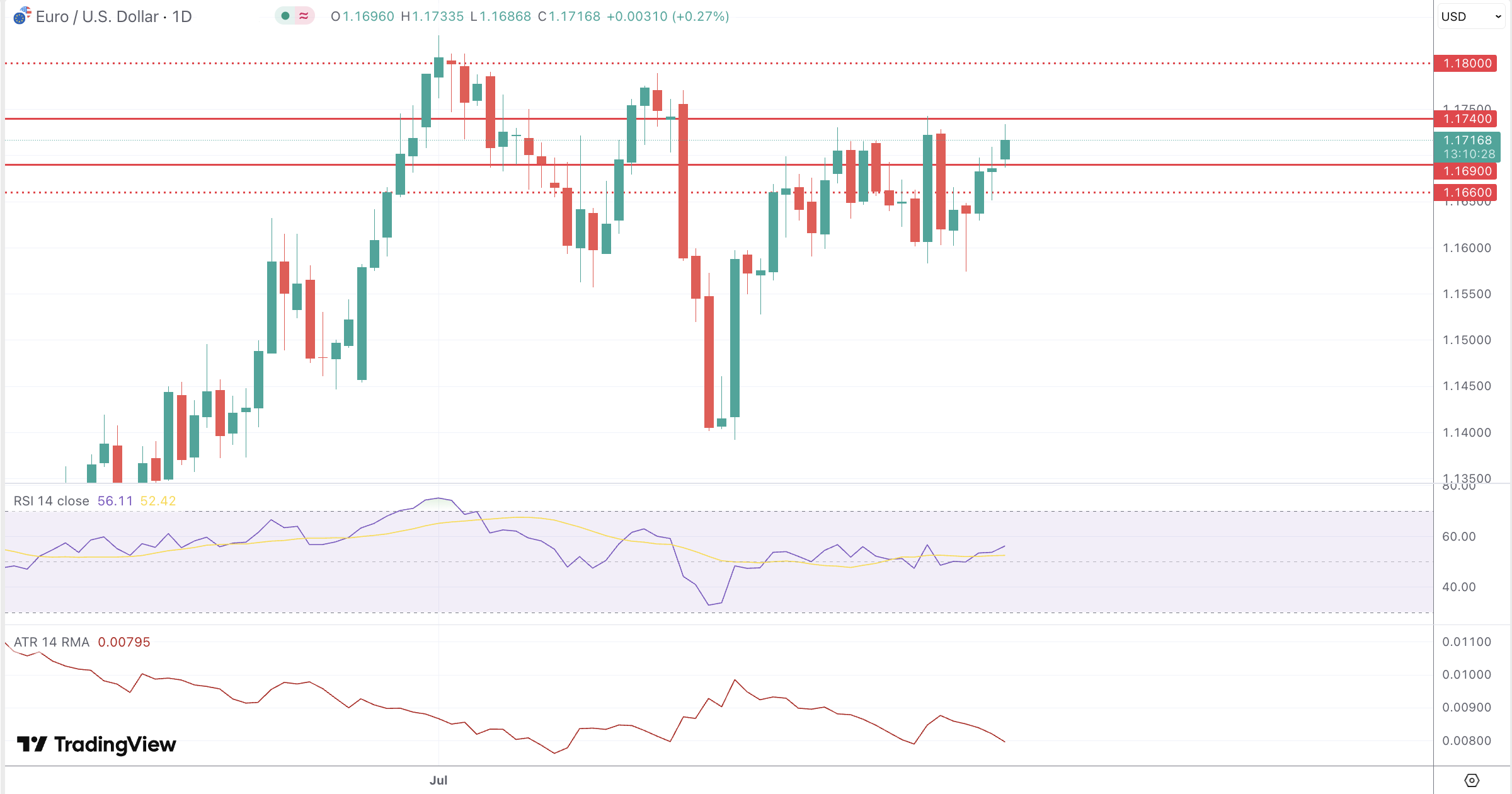
Nearby levels are well defined. Monday’s high near 1.1734 lines up with resistance at 1.1740, then 1.1800. On the downside, a recent swing low around 1.1550 anchors support, with stacked supports ahead of it at the rising 20 day average near 1.166, the 50 day near 1.167, and congestion pockets around 1.162 to 1.164 based on Fibonacci retracements of the latest upswing. A clean daily close above 1.1750 would put the early July high near 1.1830 back in view.
Positioning is a tailwind. CFTC data show speculative euro net longs rising back above 120k contracts into late August, a constructive signal that can amplify moves if US data underwhelm. That said, a hot NFP could trigger a positioning squeeze and a quick slide back toward the 1.166 to 1.162 zone.
Event risk is front loaded. The ISM manufacturing report lands Tuesday, services on Thursday, with payrolls Friday, all of which will steer rate differentials. Consensus is for subdued hiring after a soft July. Euro area flash HICP on Tuesday is the key domestic input for the ECB’s September deliberations.
Looking Forward
Base case for the week of September 1 to 5 is a modestly bullish range, anchored by 1.166 to 1.175. If US data are benign to soft, momentum buyers will likely lean on dips into the 20 to 50 day average cluster and press for a break through 1.1750, which would expose 1.1800 and 1.1830. If the labor report beats convincingly and lifts front end yields, expect a retracement toward 1.164 first and 1.160 to 1.155 on escalation, where the bigger trend should be stress tested rather than broken on first attempt. Keep an eye on euro inflation Tuesday for any surprise that nudges ECB rhetoric into next week’s meeting.