

Key Takeaways
- EURUSD opens the week around 1.1720 to 1.1740, just below the 1.18 cap, as markets price a 25 bp Fed cut.
- Weekly pivot sits at 1.1725, with R1 at 1.1789 and R2 at 1.1846. S1 is 1.1668 and S2 is 1.1604. 5 day average range is about 62 pips.
- Fibonacci supports from the 1.1660 to 1.1781 leg cluster at 1.1735, 1.1721, and 1.1706. A daily close below 1.1706 would hand the short term baton to sellers.
- The 50 day SMA near the mid 1.16s aligns with first weekly support, adding confluence if the pair wobbles post Fed.
- Macro mix is balanced to mildly euro supportive if the Fed outlines more easing than the ECB, which held rates last week as euro area inflation nudged up to 2.1 percent.
- Positioning is long euros around the mid 120k contracts, a cushion on dips but a volatility source around the decision.
Market Dynamics and Recent Performance
EURUSD starts the week hovering near 1.1720 to 1.1740, just under the 52 week ceiling around 1.18. The dollar is slightly softer into a central bank heavy week, with traders largely expecting the Federal Reserve to cut rates by 25 bps on September 16 to 17. The euro is digesting last week’s ECB hold while shrugging off a Fitch downgrade of France that generated only a muted FX reaction.
Dollar path is the hinge. The DXY eased toward the high 97s as markets focus on Powell’s message and the new dot plot. If the Fed hints at additional easing this year, the greenback likely remains heavy, which typically supports EURUSD on dips.
Macro backdrop for Europe is mixed. Headline euro area inflation ticked up to 2.1 percent in August while core stayed sticky around 2.3 percent, consistent with the ECB’s decision to pause. Euro zone sentiment softened in the latest Sentix survey, but that has not prevented the currency from holding higher ground.
Technical and Fundamental Influences
Last week’s range spanned a 1.1781 high and a 1.1660 low, with Friday’s close near 1.1733. That prints a weekly pivot at 1.1725, first resistance at 1.1789, and second resistance at 1.1846. Support sits at 1.1668 and then 1.1604. The 5 day average range ran about 62 pips, so expect intraday breakouts to require a catalyst.
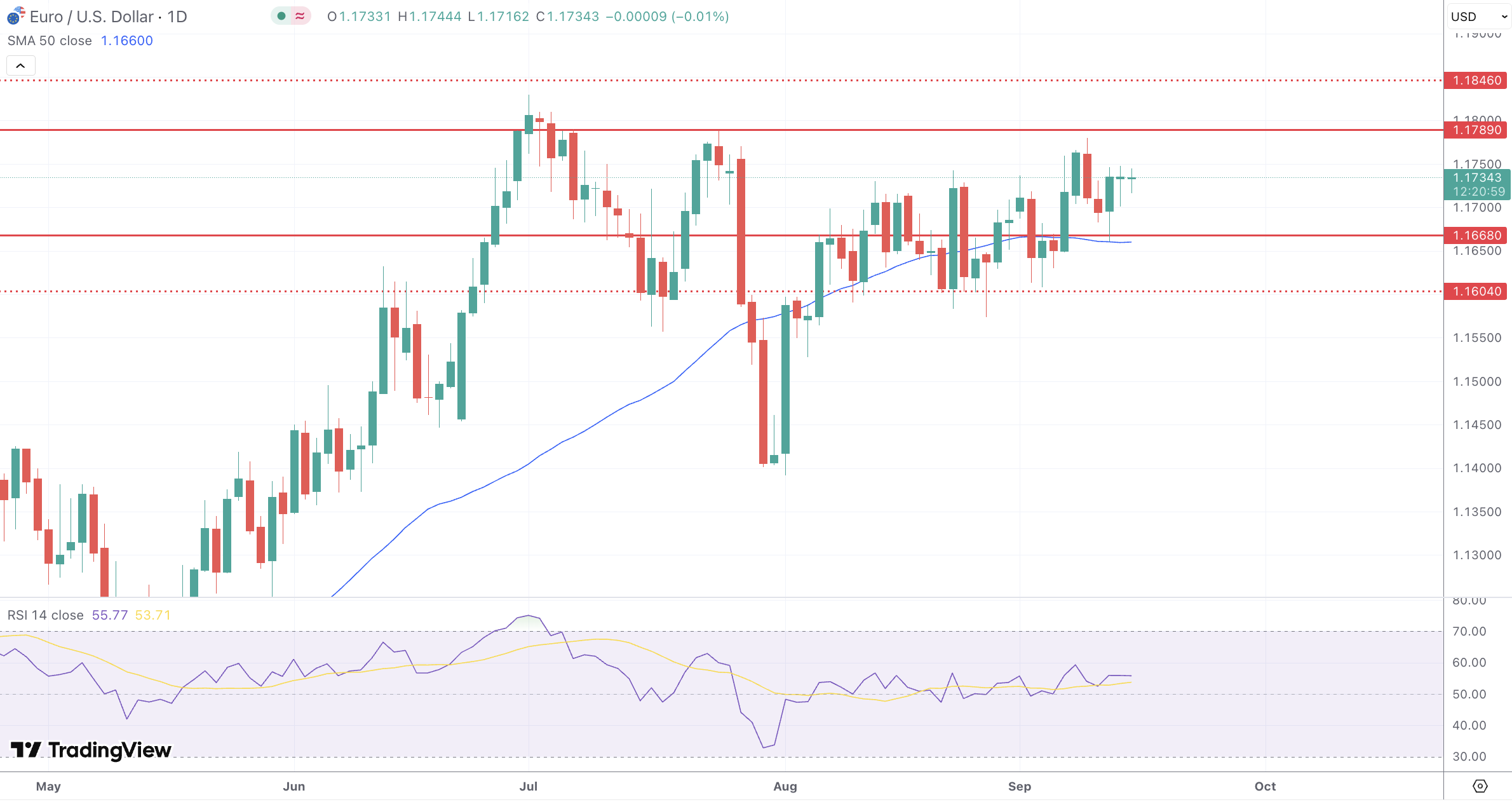
Measuring the 1.1660 to 1.1781 upswing, retracement cushions cluster at 1.1735, 1.1721, and 1.1706. That stack coincides with the weekly pivot and reinforces a dense demand zone into the mid 1.17s. A daily close below 1.1706 would warn that momentum is fading toward 1.1668.
The pair has repeatedly stalled at the 1.1780 to 1.1800 shelf. Short term dynamics remain constructive while price holds above the 50 day SMA near the mid 1.16s, which aligns with the first weekly support. A clean break and hold above 1.1800 would mark a fresh leg higher.
U.S. 10 year yields hover near 4.0 percent while German 10 year yields sit around the high 2.6s. That spread remains euro supportive if the Fed signals a more extended cutting cycle than the ECB, which just reiterated that policy is in a “good place”.
Speculative euro longs remain elevated around the mid 120k contracts on the latest CFTC print, a tailwind on dips but a source of two way volatility around the Fed if the dollar squeezes.
Looking Forward
Base case is a choppy but upward leaning range while the market waits for the Fed. On a 25 bp cut with guidance that leaves the door open to further 2025 easing, EURUSD likely challenges 1.1789 to 1.1800. A daily close above 1.1800 would expose 1.1846 and then the round number gravity at 1.1900. If Powell leans guarded and the dot plot pushes back on additional cuts, look for a fade toward 1.1706, then 1.1668. The larger bull trend only meaningfully erodes below 1.1604.
Event risk this week is concentrated on the Fed statement, SEP, and press conference. Secondary drivers include U.S. data around consumption and any fresh headlines on European fiscal dynamics after the French rating action. Tactically, respect the 1.1735 to 1.1706 congestion on dips and the 1.1780 to 1.1800 cap on pops until the Fed provides direction.