
Key Takeaways
- Gold is trading near $4,077, well above former resistance lines and now in new territory
- Technicals remain bullish: major MAs upward, momentum strong, but overbought zones are warning of pullbacks
- Immediate resistance lies in the $4,100–$4,120 area, extension potential toward $4,150+
- Support sits in the $4,000–$4,020 zone, with deeper floors near $3,970 and $3,944
- Trade plan: if bullish conditions continue, use dips to reload; if reversal signs appear, protect with stops or partial exits
Market Dynamics and Recent Performance
With gold hovering near $4,075–$4,080, the metal is operating comfortably above prior resistance thresholds and consolidating its status in fresh high ground. Recent headline developments—ranging from trade tensions and tariff rhetoric to uncertainty over U.S. political gridlock—have kept safe-haven demand alive and created an environment where bulls can maintain confidence.
The dollar has shown weakness against major currencies, reinforcing the tailwinds for gold. In intraday action, gold has been testing the upper end of its recent short-term ranges, sometimes pulling back to digest gains before resuming upward attempts. The psychological importance of $4,000 now gives way to new focal zones in the $4,050–$4,120 belt as critical territory.
Technical and Fundamental Influences
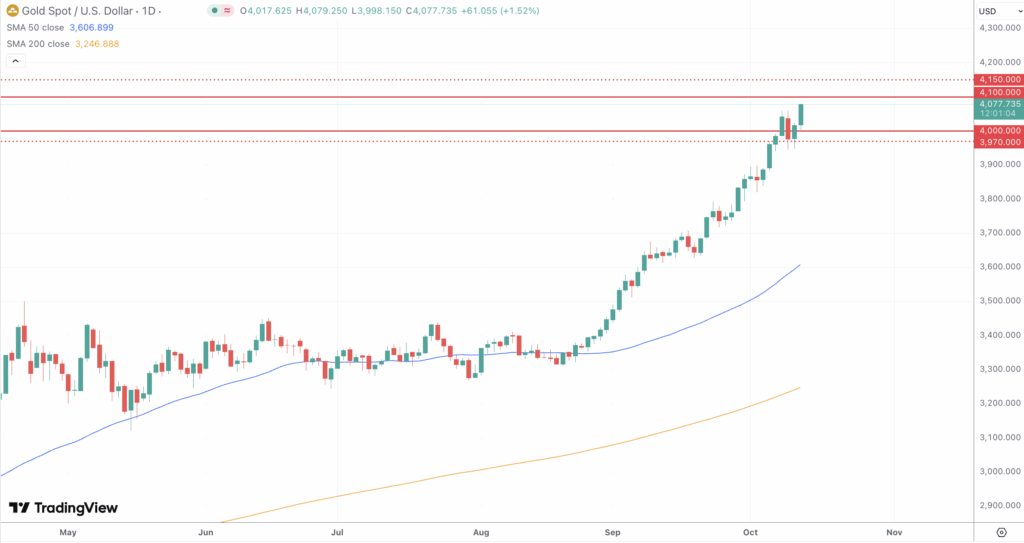
On a technical basis, the trend remains clearly bullish. The current price is well above the 50-day and 200-day moving averages, both of which are sloping upward, confirming medium-term and longer-term strength.
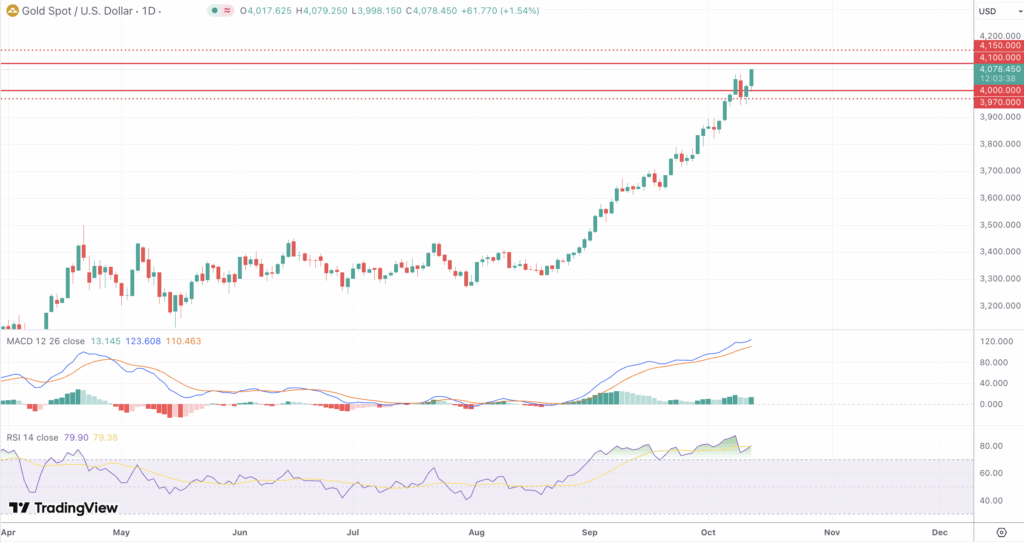
On oscillators, the 14-period RSI is now deep in overbought territory, indicating that momentum is strong but also warning of possible retracements or range-bound pauses. The MACD histogram remains positive and expanding, and the ADX (average directional index) signals a firm trend strength, though fading momentum spikes could invite reversals. A break above $4,100–$4,120 would validate continuation toward $4,150 and, in extension, a stretch toward the $4,200s.
On the downside, the immediate support floor lies in the $4,000–$4,020 zone, followed by deeper supports near $3,970 and $3,944. Should sentiment shift, a pullback toward $3,900+ could become more probable.
From the fundamental side, the backdrop continues to favor gold. Market consensus anticipates further loosening of U.S. monetary policy, which would reduce real yields and weaken dollar denominated assets. Central banks are still large buyers of gold, absorbing available downward pressure. Inflows into gold-backed ETFs remain buoyant, and investor positioning still suggests room for further accumulation. In parallel, macro uncertainty—be it from trade friction, fiscal pressures, or geopolitical developments—offers recurring triggers for flights into non-yielding assets like gold.
hat said, these drivers are well known and increasingly priced in, so incremental positive surprises (e.g. dovish Fed cues) will matter more than baseline expectations.
Looking Forward
Given that gold is already trading near $4,077, traders should expect a somewhat narrower but still dynamic range unless new impulses arrive. If the dollar weakens further or the Fed gives stronger dovish signals, gold could re-accelerate toward $4,120 and beyond to $4,150 or even $4,200 in a sustained move. In that scenario, watching for confirmation via sustained daily closes above $4,100 will be key.
On the flip side, a hawkish surprise or easing of geopolitical stress could cause a sharper reversion toward $4,020, possibly even dipping into the $3,970–$3,944 support region. Momentum traders may look to take profits near the upper resistance zone and re-enter on corrective dips, while trend-followers should aim to carry exposure as long as gold holds above $4,020. Stops should be placed with care—if price drops back below $4,000 cleanly, that could signal at least a short-term weakening.
Given how far gold has already run, increased volatility is the more likely path: expect occasional intraday spikes or whipsaws, especially on monetary policy statements or important economic releases. Monitoring dollar strength, Treasury yields, and central bank commentaries will remain crucial.