

Key Takeaways
- BTC/USD trades around $85,700, down 30%+ from the October all-time high of $126,251 and approximately 22% month-over-month
- Record ETF outflows of $3.79 billion in November, with BlackRock’s IBIT losing over $2 billion in redemptions
- RSI at 22-23 signals deeply oversold conditions; Fear & Greed Index at 13 indicates “Extreme Fear” and potential capitulation
- Key support: $85,000, $80,000, $75,000; resistance at $90,000, $95,000, and $100,000-$103,000
- Approximately $1 billion in liquidations occurred when BTC broke below $90,000; potential $4-6 billion in forced selling from overleveraged treasuries ahead
- Fed rate cut odds at 67-70% for December; U.S. data releases (GDP, PCE) this week will be decisive for risk sentiment
- Institutional accumulation continues despite outflows—Harvard tripled IBIT holdings; 15% of BTC supply now held by corporations and funds
- Long-term forecasts remain bullish with $100,000-$150,000 targets for late 2025 if macro conditions improve
Bitcoin enters the final week of November under significant pressure, trading around $85,700 after enduring one of the harshest Q4 corrections in recent memory. The flagship cryptocurrency has tumbled more than 30% from its early October all-time high of $126,251, with record ETF outflows and macroeconomic headwinds driving the aggressive selloff.
Market Dynamics and Recent Performance
BTC/USD is hovering near $85,700 as of Monday, November 24, 2025, representing a decline of approximately 22% over the past 30 days and nearly 8% over the past week. Despite the steep correction, Bitcoin remains positive year-to-date with gains of around 10%, though it briefly threatened to erase all 2025 profits when it dropped below $90,000 earlier this month.
The primary catalyst for the recent weakness has been unprecedented ETF outflows. U.S.-listed spot Bitcoin ETFs have registered record redemptions totaling $3.79 billion in November, surpassing the previous peak of $3.56 billion seen in February. BlackRock’s IBIT, the world’s largest publicly-traded Bitcoin fund, has experienced redemptions exceeding $2 billion this month alone. On a single day last week, these funds saw outflows of over $900 million—the second-largest single-day withdrawal since the products launched in January 2024.
The Fear & Greed Index has plunged to 13, indicating “Extreme Fear” among market participants—a level historically associated with capitulation phases. Market sentiment stands at approximately 18% bullish according to technical indicators, though community sentiment surveys show more resilience at around 82% bullish, reflecting the divergence between short-term traders and long-term holders.
The extended U.S. government shutdown has compounded market uncertainty by disrupting economic data releases and sapping liquidity from risk assets. Meanwhile, Federal Reserve rate cut expectations have swung wildly, with markets now pricing approximately 67-70% odds of a December cut after comments from NY Fed President Williams, though divided FOMC minutes suggest the outcome remains uncertain.
Technical and Fundamental Influences
From a technical standpoint, Bitcoin is firmly in bearish territory on short-term timeframes. The cryptocurrency is trading within a falling trend channel, signaling increasing pessimism among investors. The 50-day moving average is declining and currently sits around $105,000, while the 200-day moving average holds near $110,000, both well above current price levels.
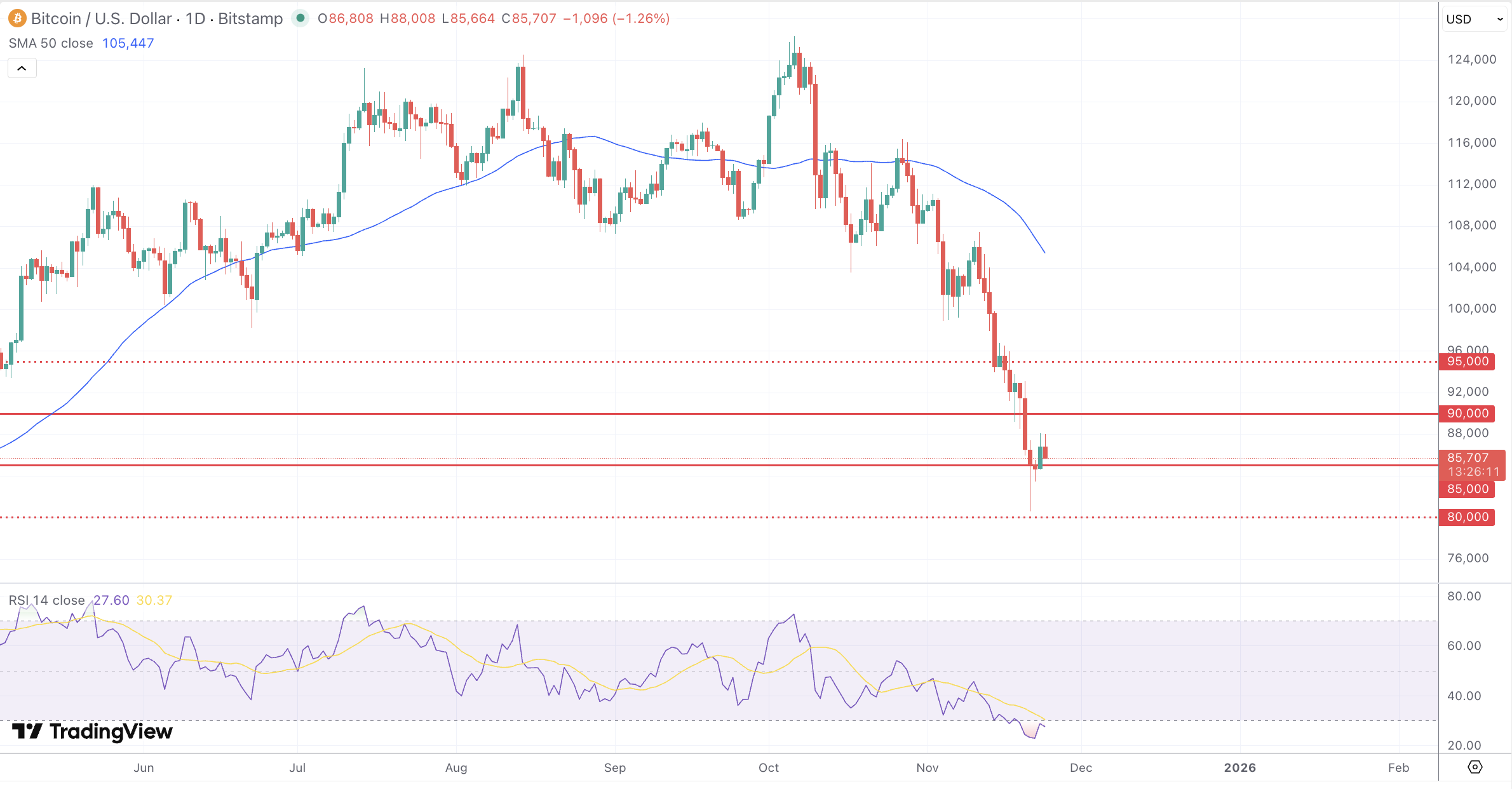
The 14-day RSI has dropped to approximately 22-23, placing Bitcoin deep in oversold territory. While this typically suggests the asset is due for a bounce, it also confirms the strength of bearish momentum. Historical precedent shows that oversold conditions in major assets can persist or even deepen before meaningful reversals occur. The MACD indicator shows expanding negative momentum, with the signal line trending downward and red histogram bars lengthening.
Key support levels include $85,000 (recent lows), $80,000 (psychological level), and $75,000-$76,500, which represents a critical zone where analysts expect dip buyers to emerge. A breakdown below $75,000 could expose Bitcoin to further losses toward $70,000-$72,000. On the upside, immediate resistance stands at $90,000, followed by $95,000 (50-day MA region), $100,000 (psychological barrier), and $103,000-$107,500 near the 200-day MA.
On-chain data reveals significant deleveraging has occurred, with approximately $947 million to $1 billion in liquidations triggered when Bitcoin broke below $90,000. Earlier waves of forced selling flushed over $1.1 billion in leveraged positions—a classic “wipeout” scenario that often precedes medium-term bottoms. Reports also highlight potential forced selling of $4.3-$6.4 billion from overleveraged Digital Asset Treasury Companies (DATCos) as covenant triggers approach.
Despite institutional headwinds, notable accumulation continues. Harvard University reportedly tripled its Bitcoin ETF holdings to $443 million via BlackRock’s IBIT, and approximately 15% of Bitcoin’s supply is now held by corporations and funds—a sign of deep institutionalization that some analysts describe as an “IPO moment” for the asset class.
Looking Forward
The outlook for Bitcoin this week remains highly uncertain, with technical indicators suggesting oversold conditions but no clear signs of trend reversal. Analysts expect BTC/USD to trade within a range of approximately $85,000-$90,000, with potential for sharp moves in either direction given thin Thanksgiving liquidity on November 27.
Critical U.S. economic data releases—including PPI, Retail Sales, Q3 GDP, and PCE inflation—will shape Fed expectations and risk appetite. Hawkish data prints could extend the selloff toward $80,000, while dovish surprises supporting December rate cut expectations could trigger a relief rally toward $95,000.
ETF flows will be closely monitored. A shift back to net inflows would signal that institutional rebalancing is largely complete and could provide a floor under prices. Conversely, continued redemptions would maintain downward pressure. Standard Chartered’s Geoffrey Kendrick frames the selloff as a “fast but familiar correction” rather than the start of a structural bear market, viewing ETF outflows as basis trades being unwound rather than institutions abandoning Bitcoin.
Longer-term forecasts remain constructive. Analysts project Bitcoin could reach $100,000-$130,000 by year-end if macro conditions stabilize and ETF inflows resume. Some models target $150,000+ by late 2025, supported by halving-driven scarcity, institutional adoption, and Bitcoin’s evolving role as a hedge against fiat currency debasement and geopolitical risk.