

Key Takeaways
- EUR/USD is trading at $1.1567, below the 200-day EMA ($1.1589) for the first time in months, a technically significant breakdown shifting the short-term argument to the bears.
- MACD (12,26,9) reads -0.00274 / -0.00514 / -0.00240 with the histogram extending lower, confirming accelerating bearish momentum with no reversal signal in sight.
- Immediate resistance sits at the $1.1589 200 EMA and the $1.1628–$1.1650 former support zone, now flipped to overhead supply, with the 5-day MA at $1.1603 adding to the cluster.
- Key downside levels are $1.1491 (50% Fibonacci retracement), $1.1469, and $1.1392; a weekly close below $1.1491 opens a deeper corrective leg.
- US CPI midweek and the March 17–18 FOMC are the dominant event risks; dovish Fed guidance or a soft inflation print could trigger a sharp technical relief rally.
- The medium-term structural case remains constructive — Fed easing, ECB on hold at 2.00%, and German fiscal expansion point toward $1.20+ — but near-term price action demands caution.
Market Dynamics and Recent Performance
EUR/USD enters the week of March 9 under pronounced selling pressure, trading at $1.1567 after registering a session open of $1.1549, a high of $1.1573, and an intraday low of $1.1507, posting a daily loss of -0.43%. The decline extends a sharp multi-week pullback from the February peak near $1.2070, the highest print in several years, with the reversal erasing more than 500 pips from the highs in a matter of weeks.
The dollar’s partial rehabilitation has been the primary driver. After spending much of late 2025 and early 2026 in structural retreat, the greenback is finding renewed support in US economic data that resists a clean narrative of deterioration. Non-farm payrolls and recent jobless claims prints have reaffirmed that the labour market, while softening at the margins, is not delivering the sustained weakness needed to push the Federal Reserve toward aggressive easing. This resilience has squeezed the euro from the top of its range even as broader structural forces tilt medium-term expectations in the single currency’s favour.
Geopolitical developments have compounded the pressure. Military conflict in the Middle East in early March prompted a defensive rotation into the dollar as a safe-haven asset, accelerating the break through support levels that had previously held. Risk appetite across G10 currencies deteriorated, with the euro bearing a disproportionate share of the adjustment given its elevated positioning. Eurozone economic data nonetheless remains on a slow but stable footing, with domestic demand gradually replacing export-led growth as the primary regional engine.
Technical and Fundamental Influences
The technical picture has deteriorated sharply on the daily timeframe. The most significant development is the break below the 200-day EMA, currently at $1.1589, with price now trading at $1.1567, below this long-term dynamic support for the first time in months. The 200 EMA had served as a reliable floor during corrective episodes throughout the 2025–2026 advance; its loss shifts the structural argument firmly to the bears.
The MACD (12,26,9) reinforces the case. The MACD line sits at -0.00274, the signal line at -0.00514, and the histogram at -0.00240. All three readings are negative, the histogram bars are extending lower, and there is no sign of a bullish crossover or contraction suggesting selling pressure is abating. The ADX is trending higher from the low-20s, confirming trend strength is building rather than dissipating, a clear warning against premature counter-trend positioning.
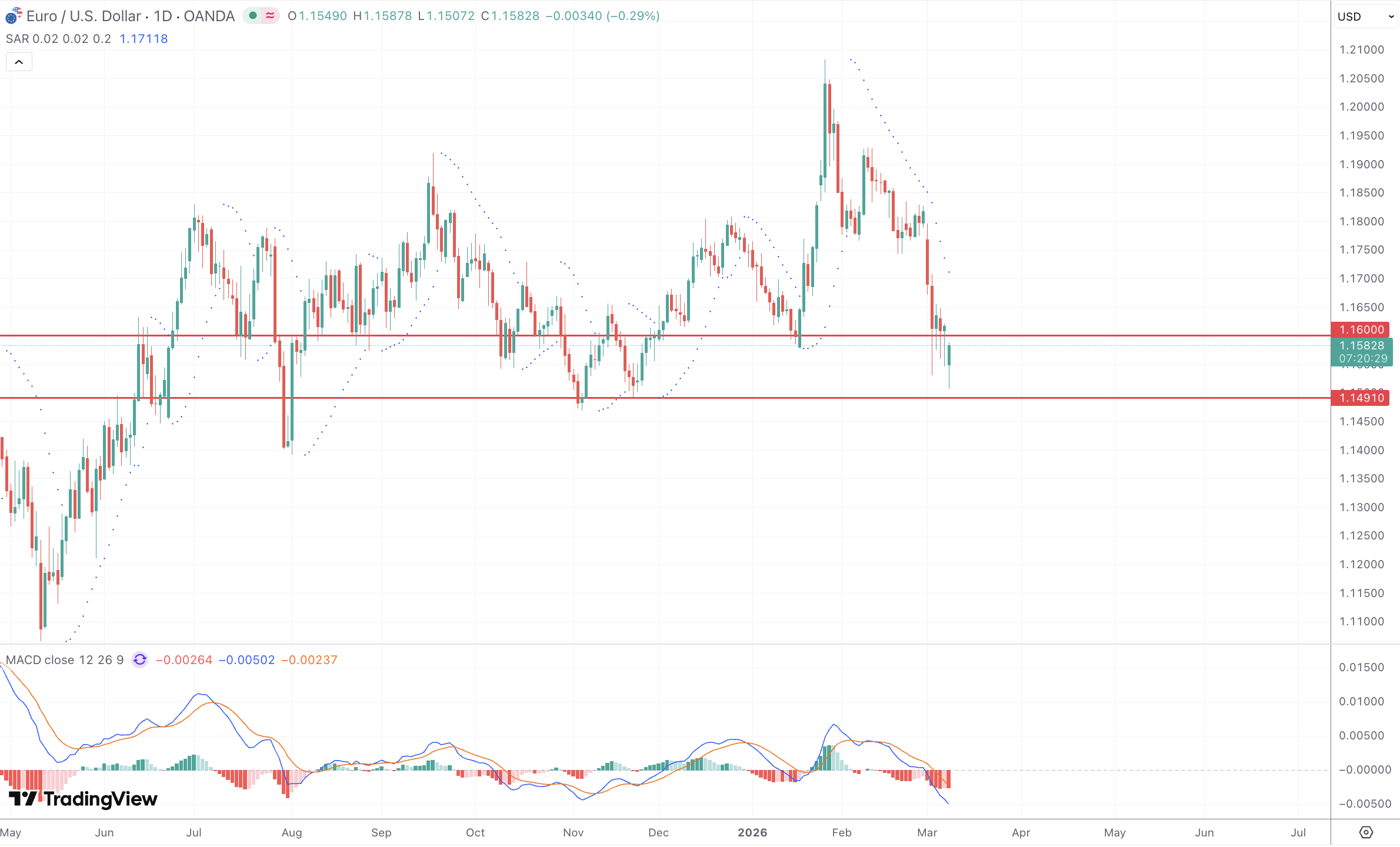
The 5-day MA at $1.1603 sits above current price, adding to the overhead resistance cluster alongside the former 200 EMA. From a Fibonacci perspective, the 38.2% retracement of the broader 2025 advance sits near $1.1578, closely matching current price action, while the 50% retracement at $1.1491 and $1.1469 are the next meaningful downside targets. The Parabolic SAR remains in bearish mode, trailing above price, and ATR readings indicate intraday ranges of 60–80 pips, keeping position sizing critical. On the upside, price must reclaim the $1.1589 200 EMA and the $1.1628–$1.1650 zone, previously solid support, now converted to resistance, before any recovery thesis holds. Above that, $1.1732–$1.1770 represents the next supply cluster.
On the fundamental side, the divergence between the Federal Reserve and the ECB remains the governing framework. The Fed holds at 3.50%–3.75% with markets pricing two additional cuts across the year; Goldman Sachs points to March and June as the most probable dates. The March 17–18 FOMC dominates positioning this week. A dovish shift in the dot plot could trigger a sharp snap-back rally given the extent of the sell-off; a resilient data story heading into that meeting would add further pressure on $1.1491. The ECB, holding its deposit rate at 2.00%, provides structural support through the rate differential channel, with Germany’s €500 billion infrastructure and defence spending program serving as the medium-term fundamental tailwind. US tariffs of 10–20% on EU goods remain a tangible headwind that could interrupt euro strength if implemented in full.
Looking Forward
The week ahead is shaped by two competing dynamics: the continuation of bearish technical momentum and the gravitational pull of the approaching FOMC. US CPI data midweek is the immediate event risk. A hotter-than-expected print in services inflation would give dollar bulls fresh ammunition and increase pressure on $1.1491. A softer reading would reignite Fed cut pricing and spark a recovery toward $1.1589–$1.1650, contingent on whether price can convincingly reclaim the 200 EMA.
The near-term bias is bearish below $1.1589. Traders watching for reversal signals should focus on candlestick patterns near the $1.1491–$1.1507 area, Monday’s intraday low, as any decisive bounce from that zone would be the first sign of seller exhaustion. The RSI approaching oversold territory raises the probability of a relief move, but the ADX and MACD configuration argue against treating any bounce as a sustained recovery without confirmation. For the week, the expected trading range is $1.1491–$1.1664. Rallies into $1.1589–$1.1628 represent resistance and potential shorting opportunities; a clean daily close above $1.1650 would challenge that view. A weekly close below $1.1491 opens the path toward $1.1392 with little structural support in between. The medium-term thesis, anchored to the narrowing Fed-ECB rate differential and Germany’s fiscal expansion, remains intact on a multi-month horizon, but the near-term chart is firmly in bearish hands.
The 5-day MA at $1.1603 sits above current price, adding to the overhead resistance cluster alongside the former 200 EMA. From a Fibonacci perspective, the 38.2% retracement of the broader 2025 advance sits near $1.1578, closely matching current price action, while the 50% retracement at $1.1491 and $1.1469 are the next meaningful downside targets. The Parabolic SAR remains in bearish mode, trailing above price, and ATR readings indicate intraday ranges of 60–80 pips, keeping position sizing critical. On the upside, price must reclaim the $1.1589 200 EMA and the $1.1628–$1.1650 zone, previously solid support, now converted to resistance, before any recovery thesis holds. Above that, $1.1732–$1.1770 represents the next supply cluster.
On the fundamental side, the divergence between the Federal Reserve and the ECB remains the governing framework. The Fed holds at 3.50%–3.75% with markets pricing two additional cuts across the year; Goldman Sachs points to March and June as the most probable dates. The March 17–18 FOMC dominates positioning this week. A dovish shift in the dot plot could trigger a sharp snap-back rally given the extent of the sell-off; a resilient data story heading into that meeting would add further pressure on $1.1491. The ECB, holding its deposit rate at 2.00%, provides structural support through the rate differential channel, with Germany’s €500 billion infrastructure and defence spending program serving as the medium-term fundamental tailwind. US tariffs of 10–20% on EU goods remain a tangible headwind that could interrupt euro strength if implemented in full.