

Key Takeaways
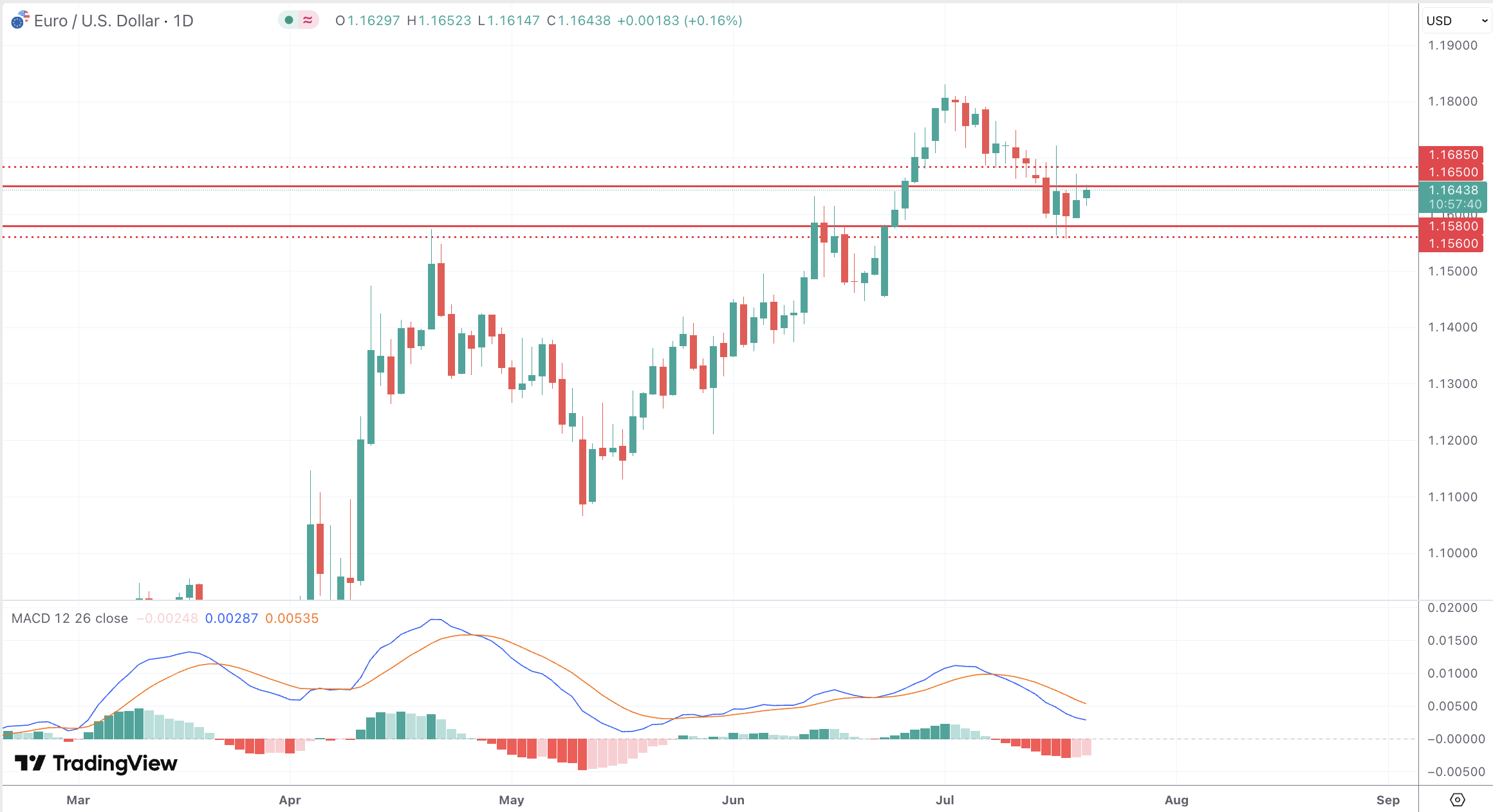
- EUR/USD traded between 1.1550 and 1.1685 last week, closing around 1.1630.
- Short‑term momentum shows RSI near 45 and MACD flattening below zero, hinting at waning bearish bias.
- Technical support sits at 1.1580 and 1.1560 (23.6% Fib), with resistance at 1.1650, 1.1685, and 1.1750.
- ECB’s paused policy stance versus Fed’s data‑driven resilience underpins the dollar’s strength.
- Upcoming ECB remarks, Eurozone confidence readings, and U.S. durable goods will shape the next directional bias.
Market Dynamics and Recent Performance
EUR/USD spent the past week confined to a tight 1.1550–1.1685 corridor, reflecting a balance between supportive dollar flows and tentative euro-strengthening headlines. The pair dipped to a fresh weekly low of 1.1555 before rebounding into the 1.1650 area, ultimately settling near 1.1630 by Friday’s close. This narrow trading band underscores traders’ hesitancy amid muted macro releases and looming central bank meetings. Volatility remained subdued, with the average true range contracting roughly 15 pips compared to the prior week.
Technical and Fundamental Influences
From a technical standpoint, EUR/USD sits just below its 50‑day simple moving average (around 1.1625), which has capped rallies twice over the last five sessions. The longer‑term 200‑day SMA near 1.1450 lies well below current levels, indicating the broader uptrend since April remains intact. Short‑term momentum indicators show the daily Relative Strength Index hovering near 45, below neutral but above oversold conditions, while the MACD histogram, though still in negative territory, is flattening, suggesting bearish pressure is fading. Immediate support lines up at 1.1580 (recent swing lows), followed by the 23.6% Fibonacci retracement of July’s rally near 1.1560. On the upside, initial resistance resides at 1.1650, with a break above 1.1685 exposing the 61.8% retracement around 1.1710 and the round‑number barrier at 1.1750.
On the fundamental front, the European Central Bank’s decision to pause rates at 2.15% has underpinned a softer euro, as market participants weigh the prospects of further policy easing later in the year. Conversely, the Federal Reserve’s firm messaging has buoyed the dollar, reinforced by U.S. July retail sales that beat forecasts and weekly jobless claims falling to multi‑month lows. Geopolitical jitters—particularly fresh talks on U.S. tariffs targeting European goods—have intermittently driven safe‑haven flows, limiting the euro’s upside. In sum, the tug‑of‑war between ECB caution and U.S. economic resilience continues to define price action.
Looking Forward
Key catalysts for the coming week include ECB President speeches and Eurozone consumer confidence data, alongside U.S. durable goods orders and housing starts. A decisive move above the 1.1685–1.1700 zone would likely pave the way toward 1.1750, with a judge of euro‑zone mood on upbeat business surveys providing additional lift. Conversely, failure to defend 1.1580 risks a deeper slide toward psychological support at 1.1500, where the 200‑day SMA and May’s reversal low converge. Traders should also monitor shifts in U.S.–EU tariff negotiations, as any escalation could prompt rapid safe‑haven buying in the dollar, driving EUR/USD lower.