

Key Takeaways
- EUR/USD is trading around 1.1655, confined within a 1.1600–1.1700 range as dollar‑yield dynamics clash with eurozone growth concerns.
- Short‑term technicals are neutral: price is at the 21‑period EMA on the four‑hour chart, RSI is 47, and ATR is about 60 pips.
- Pivot points today: central at 1.1650, resistance at 1.1695 and 1.1730; support at 1.1615 and 1.1570.
- Eurozone flash PMI eased to 50.2, while U.S. durable goods orders rose 1.5 percent, reflecting mixed growth signals.
- Upcoming U.S. core PCE and eurozone retail sales will likely drive the next directional move; a breach of 1.1665 or 1.1615 on the four‑hour chart will be key.
Market Dynamics and Recent Performance
The euro opened the week under mild pressure, trading near 1.1655 as investors reassess growth differentials and central‑bank outlooks. After briefly testing resistance around 1.1700, EUR/USD drifted lower amid firmer U.S. Treasury yields and a modest uptick in dollar‑funding costs. Despite a calmer tone in global equities, risk flows into the single currency have remained muted, keeping the pair confined within a 1.1600–1.1700 range.
Technical and Fundamental Influences
On the charts, the pair is straddling its 21‑period Exponential Moving Average on the four‑hour timeframe, currently at 1.1660, signaling a neutral short‑term bias. The 14‑period Relative Strength Index sits at 47, suggesting slight downside potential before oversold conditions emerge. Average True Range has contracted to roughly 60 pips, hinting at an imminent volatility expansion.
Pivot‑point analysis for today places the central pivot at 1.1650, with immediate resistance at 1.1695 (first R1) and 1.1730 (R2), while support lies at 1.1615 (S1) and 1.1570 (S2). The Ichimoku Cloud on the daily chart remains flat between 1.1620 and 1.1680, underlining a congestion zone; a clear break above the cloud would favor further gains, whereas a drop below could trigger accelerated selling.
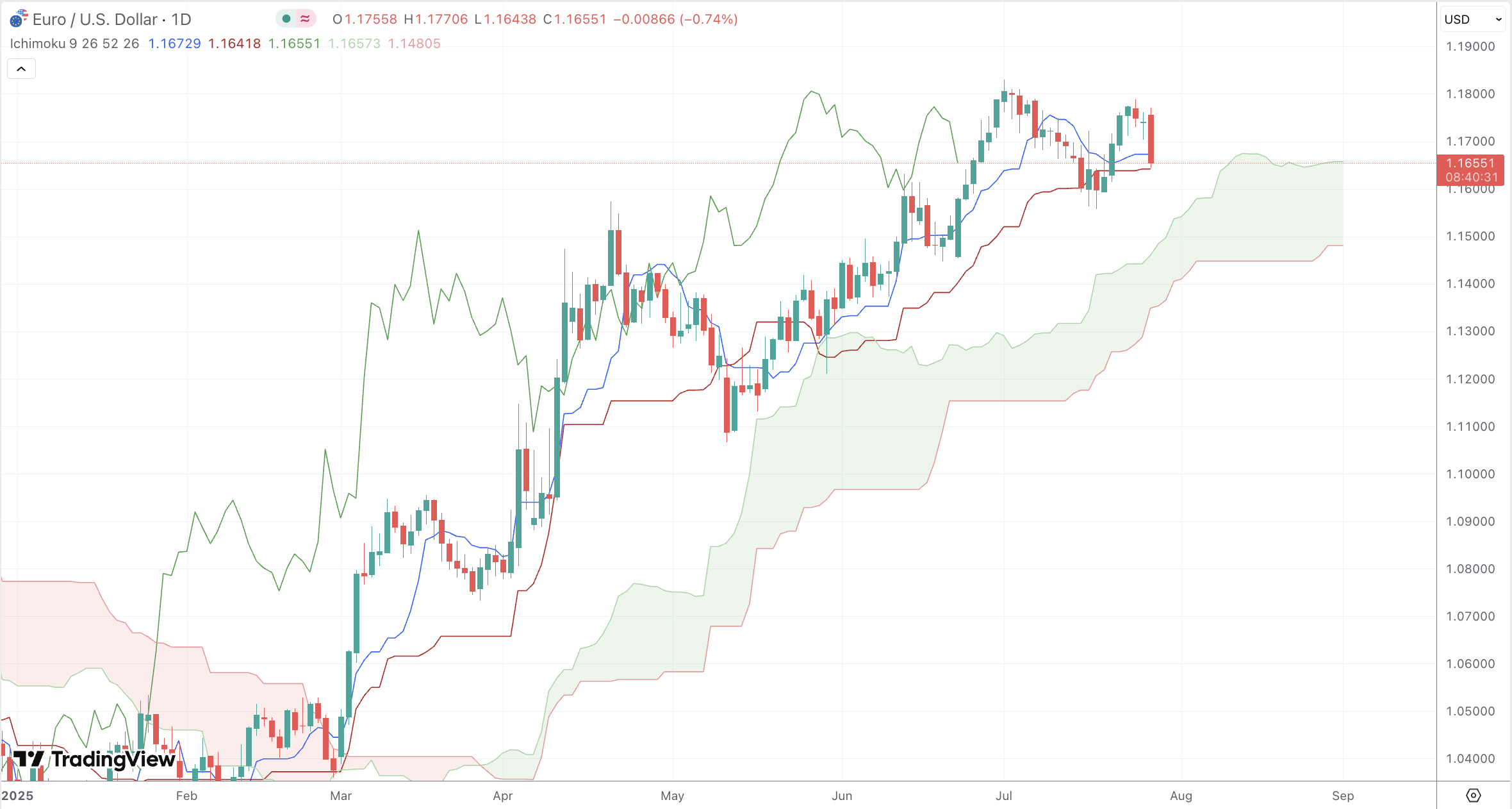
Fundamentally, eurozone activity indicators have cooled, with July’s flash composite PMI slipping to 50.2, just above the expansion threshold, while U.S. durable goods orders showed a surprising 1.5 percent rise last month. These mixed signals reinforce the tug‑of‑war between growth‑driven dollar weakness and yield‑driven dollar strength.
Looking Forward
In the days ahead, key eurozone retail sales data and the U.S. personal consumption expenditures inflation report will headline the economic calendar. Should U.S. core PCE surprise to the upside, U.S. real yields could push higher, pressuring EUR/USD toward supports at 1.1615 and then 1.1570. Conversely, a softer inflation print or dovish Fed commentary might allow the pair to reclaim 1.1700 and target 1.1730.
Traders should watch for a decisive breach of the 21‑period EMA on the four‑hour chart: a close above 1.1665 could pave the way to R1 at 1.1695, while a close below 1.1615 would open the door to S1 at 1.1570. Volatility is likely to pick up around data releases, so position sizing and risk management will be essential.