

Key takeaways
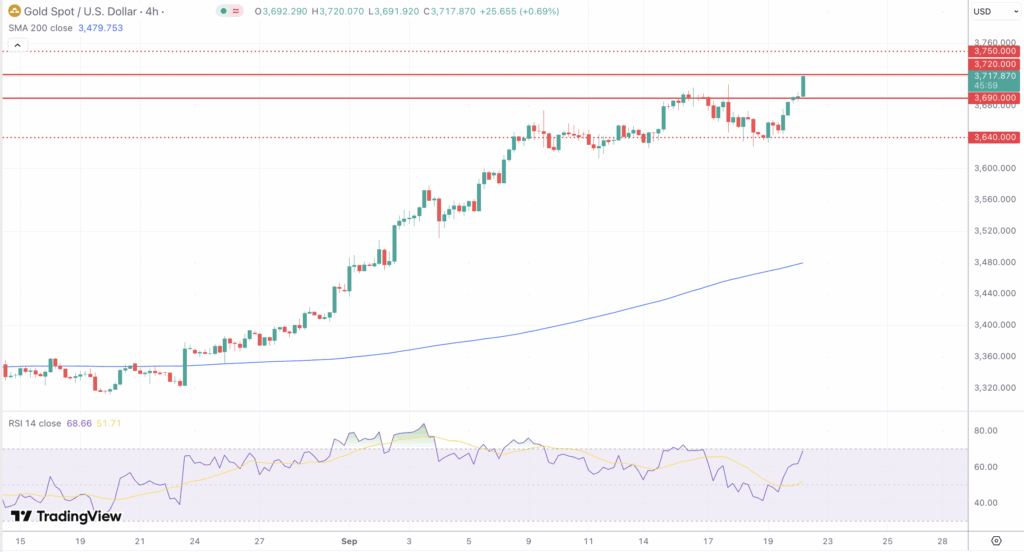
- Gold at ~$3,717 has hit a resistance cluster around $3,715–$3,720; breaking above cleanly would open a test toward $3,745–$3,750.
- Support is critical around $3,690–$3,700; a break below that zone could expose $3,660 and deeper support between $3,640–$3,650.
- Short-term technical indicators suggest overbought conditions; expect choppy trading with risk of pullbacks unless catalyzed by data.
- Fundamental drivers remain in gold’s favor: expectations of easing, inflation holding above target, safe haven demand, and central bank buying.
- Key upcoming data (PCE, CPI, PMI), and Fed speeches will likely determine whether gold pushes higher or pulls back.
Market Dynamics and Recent Performance
Gold is trading around $3,717, having pushed past recent highs thanks to renewed hopes for additional rate cuts by the Federal Reserve. The recent 25 basis point cut has already been largely priced in, and markets are now focused on forward guidance and inflation metrics to judge whether more easing is coming. Momentum remains strong as safe-haven demand, central bank purchasing, and geopolitical risks continue to feed into gold’s appeal.
Meanwhile, the U.S. dollar has shown signs of resistance in its recent soft patch, preventing gold’s upside from extending unchecked. Some retracements occurred after gold briefly broke above $3,700, as traders took profits in light of mixed signals from U.S. yields and inflation readings.
Technical and Fundamental Influences
From a technical perspective, gold is operating in a steep uptrend. The short-term charts (hourly, 4-hour) highlight that $3,715–$3,720 is now acting as an immediate resistance zone. If that area is breached with conviction, $3,745–$3,750 is likely the next hurdle, where supply and profit-taking may reemerge. Key lower support lies at $3,690–$3,700, which if broken, may expose $3,660 and further down around $3,640–$3,650. Indicators such as RSI over 1-hour and 4-hour are elevated, hinting at overextension in the short term; momentum oscillators are showing some divergence, as price highs have outpaced momentum strength.
On the fundamental side, several factors are supporting gold. First, Fed communications suggest more rate cuts may follow this year, especially if labor market softens further and inflation does not surprise to the upside. Second, inflation nowcasts are pointing to persistent pressures, core PCE and CPI measures remain above desired targets, underscoring the risk that real yields won’t rise sharply. Third, long-term investors, including central banks, have kept buying gold, strengthening the demand side. However, there is risk: U.S. Treasury yields (especially long end) have been creeping up, and dollar strength could reappear if inflation reads hot, or if any Fed official leans hawkish. Such developments could put pressure on gold in the near term.
Looking Forward
Given the confluence of technical resistance at current levels and supportive fundamentals, this week is likely to see consolidation or a modest correction unless strong upside data emerges. If gold can close one or more daily bars above $3,720–$3,725, it may attempt to test $3,745–$3,750. Weakness should emerge if gold drops below $3,700 on a sustained basis, opening up downside toward $3,660, with more substantial losses toward $3,640–$3,650 if multiple negatives align (e.g. hot inflation prints, rising yields, stronger dollar).
Major catalysts will include U.S. inflation data (especially PCE), PMI metrics, Fed Chair and governors’ speeches, and shifts in Treasury yield curves. Gold is sensitive to real interest rates; if nominal yields rise while inflation expectations don’t keep pace, that could lead to short-term pressure. But if inflation remains sticky and labor softens, gold has a strong base to regain upward momentum.