

Key Takeaways
- Bullish Breakout: Gold trading at $4,085 after breaking above $4,080 resistance (21-day SMA), confirming renewed buying momentum and shifting the near-term bias bullish.
- Strong Technical Momentum: RSI at 68 approaches overbought territory, signaling strong upside momentum. MACD at 4.12 in positive territory and price above key moving averages (50-day at $3,996) confirm the uptrend.
- Next Resistance Targets: Immediate resistance at $4,114 and $4,150, with a close above $4,114 projecting extensions toward $4,192-$4,230 by month-end.
- Support Levels: Key support at $4,042-$4,050, then $4,020-$4,030. A break below $4,000 would negate the bullish breakout and target $3,920-$3,847.
- Fed Policy: 66% probability of December rate cut following weak consumer sentiment (50.3) and October layoffs spike (+183.1%), reducing opportunity costs for holding gold.
- Central Bank Buying: China’s 11th consecutive monthly purchase and 634 tonnes of global central bank buying year-to-date provide steady demand, with 750-900 tonnes projected annually.
- Geopolitical Risk: Historic US government shutdown creates uncertainty supporting safe-haven demand, while US-China tariffs at 18.6% (highest since 1933) add inflationary pressure.
- Week Ahead: Thursday’s CPI data is the key catalyst. Bullish momentum favors continuation toward $4,150-$4,230, though RSI near overbought suggests potential for profit-taking.
- Trading Levels: Maintain long bias above $4,050; stops below $4,020 for swing trades. Resistance trades at $4,114-$4,150 require caution given strong momentum.
- Probability Shift: Bullish scenario now 50% (up from 25%) with targets at $4,150-$4,230 if momentum continues. Consolidation at 35%, bearish reversal only 15% requiring break below $4,000.
Market Dynamics and Recent Performance
Gold has surged past the psychologically significant $4,000 mark and is currently trading near $4,085, breaking above key resistance after three consecutive weekly declines. The precious metal previously closed at $4,000.57 with a modest 0.5% loss, but bulls have since reclaimed control, pushing prices decisively through the $4,080 barrier that marked the 21-day Simple Moving Average.
The yellow metal’s remarkable 2025 trajectory continues, having surged approximately 50% year-to-date before reaching the October 20 peak of $4,381.60. Following an 11.3% correction from its all-time high, the current rally toward $4,085 confirms renewed buying interest and suggests accumulation at lower levels has concluded. Trading momentum has shifted bullish as prices broke through the $3,951.68 to $4,059.90 consolidation range, with increasing volume supporting the upside move.
Technical and Fundamental Influences
Multiple technical indicators confirm strengthening bullish momentum. The Relative Strength Index sits at 68 on the 4-hour timeframe, approaching overbought territory but demonstrating strong upside momentum. The 14-period RSI supports the bullish bias, indicating buyers are in control without reaching extreme levels that typically precede reversals.
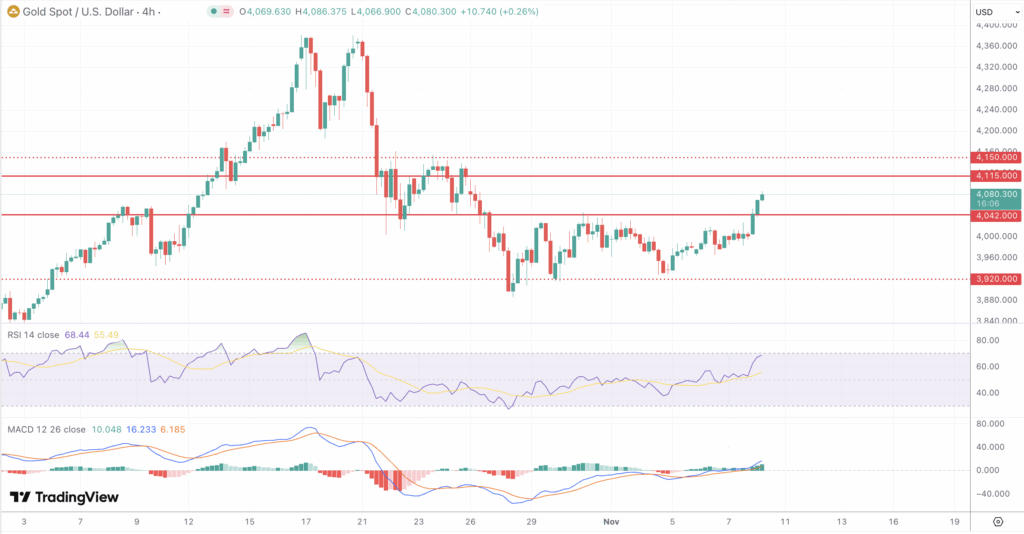
The MACD remains at 4.12 in positive territory, showing expanding bullish momentum as prices break through resistance. Moving averages confirm the uptrend with the 5-day at $4,008.71 and the 50-day at $3,996.41 now acting as support. Price trading at $4,085 has successfully breached the 21-day SMA near $4,080, a significant technical achievement signaling renewed strength. Bollinger Bands show the upper band near $4,114 as the next target, with the lower band at $3,835 providing distant support.
Fibonacci analysis identifies former resistance at $4,007 and $4,042 now converted to support. The next major resistance sits at $4,114, followed by $4,150. A close above $4,114 projects extensions toward $4,192-$4,230. Key support rests at $4,042, then $4,020-$4,030, with critical defense at the $4,000 psychological level.
On fundamentals, markets price in 66% probability of a December Fed rate cut following the University of Michigan Consumer Sentiment Index plummeting to 50.3 and Challenger reporting a 183.1% surge in October layoffs. The ongoing government shutdown has created a data vacuum complicating Fed decisions, yet the commitment to easing remains firm.
Central bank demand provides structural support, with China’s 11th consecutive monthly purchase elevating reserves to 2,303.5 tonnes. Global central bank purchases reached 634 tonnes year-to-date, with the World Gold Council projecting 750-900 tonnes annually. US-China trade tensions persist with tariff rates at 18.6%—the highest since 1933—creating inflationary pressures that benefit gold, though any substantial negotiation progress could reduce safe-haven demand. Dollar weakness has provided tailwinds, with the Dollar Index showing atypical vulnerability that supports gold prices.
Looking Forward
The week ahead promises continued volatility with Thursday’s CPI inflation data as the primary catalyst. September’s annual CPI remained at 3.0%, and any deviation could trigger substantial price action. The potential government shutdown resolution adds another variable, with US Senate advancing measures Monday that could initially pressure gold, though current momentum suggests bulls remain in control.
With price at $4,085, gold has successfully broken above the $4,080 resistance, shifting the immediate bias bullish. The next targets are $4,114 and $4,150, with momentum indicators supporting further upside. However, RSI at 68 suggests caution as the market approaches overbought conditions where profit-taking could emerge. Key support now rests at $4,042-$4,050, with more substantial defense at $4,020-$4,030. A pullback below $4,000 would negate the bullish breakout and shift focus back to the $3,920-$3,930 zone.
Three scenarios remain: the bullish case (now 50% probability) sees continuation toward $4,150-$4,230 if CPI data supports Fed easing; a consolidation scenario (35%) envisions choppy trading between $4,020-$4,114 as the market digests gains; while a bearish reversal (15%) requires a break below $4,000 and would target $3,920-$3,847, likely needing unexpectedly strong economic data or hawkish Fed rhetoric.