
Key Takeaways
- Gold is trading at $4,990, down 0.60% on the session, having corrected nearly 8% from the March high of $5,420 and 10.8% from the all-time high of $5,595 on January 29.
- The FOMC rate decision on March 18 is the week’s dominant risk event; the hold is fully priced, but the dot plot and Powell’s tone on the 2026 rate path are the real market movers.
- RSI at 38.2 approaches oversold, the Parabolic SAR remains bearish, and MACD at -23 sits in negative territory with histogram compression indicating fading downside momentum.
- The 50% Fibonacci retracement at $4,988 aligns with the $5,000 psychological level; a sustained daily close below this zone opens exposure toward the 61.8% retracement at $4,845.
- Bollinger Bands show price testing the lower band between $4,960 and $5,000; OBV deterioration since $5,420 signals institutional distribution pressure.
- The EMA complex is bearishly configured short-term, with the 5-day ($5,015), 20-day ($5,125), and 50-day ($4,945) EMAs acting as sequential resistance above spot.
- A recovery through $5,208 on volume reopens the bullish thesis toward $5,267 and $5,321; the all-time high at $5,595 remains the secular upside reference.
- Stagflation risk from oil above $100 creates dual-directional pressure: safe-haven demand supportive, but inflation-driven rate expectations and dollar strength weigh on the non-yielding metal.
- The 200-day EMA at $4,054 anchors the secular bull trend; the current move is a correction within an intact structure, not a reversal.
- Universal tariffs at 10% with escalation risk to 15%, alongside persistent central bank demand, continue to act as structural floor supports beneath near-term corrective pressure.
Market Dynamics and Recent Performance
Gold’s retreat from its early-March peak near $5,420 has been one of the more technically instructive moves of the year, peeling back nearly 8% before finding tentative footing in the $4,990 to $5,020 zone. The daily chart’s current OHLC reads O: $5,014, H: $5,036, L: $4,967, C: $4,990, closing down 0.60% on the session and printing a second consecutive week in the red. The longer-term structure, however, remains intact: the move from below $3,400 in the second half of 2025 to the all-time high of $5,595 on January 29, 2026 traced a run of nearly 65% across twelve months. That trend has not reversed; it has corrected.
The week ahead is dense with event risk. The Federal Reserve’s March 18 FOMC rate decision is the dominant calendar event, with futures markets pricing a 99% probability of an unchanged rate at the current 3.50 to 3.75% band. The meeting’s real weight lies in the updated Summary of Economic Projections: any signal that the single rate cut penciled in for 2026 is being deferred to 2027 would reinforce the higher-for-longer narrative and lift the US dollar against gold. February PPI data lands on the same day, followed by initial jobless claims on March 19, creating a compressed window of volatility likely to define gold’s direction through month-end.
The US-Israel military engagement with Iran has escalated meaningfully, driving crude oil through $100 per barrel and reigniting stagflation concerns that have caused markets to sharply scale back rate-cut expectations. For gold, this is a double-edged dynamic: the geopolitical shock and safe-haven premium are supportive, but the associated inflation and resulting dollar strength create headwinds for a non-yielding asset.
Technical and Fundamental Influences
The technical picture on the daily timeframe shows clear short-term deterioration within a structurally bullish longer-term channel. The 5-day EMA has crossed below the 50-day EMA, pulling the MACD histogram deeper into negative territory. The MACD line sits near -23, below its signal line and beneath the zero mark, though the histogram is beginning to compress, consistent with a corrective move losing momentum rather than accelerating. The RSI on the 14-period daily reads 38.2, approaching oversold territory without yet reaching the levels that have historically triggered sharp mean-reversion bounces. A Bullish Engulfing candlestick has formed near the $5,052 support zone, indicating tentative buyer interest, though volume confirmation has been inconsistent.
The EMA complex provides a clear structural map. The 200-day EMA at $4,054 confirms how far above long-term equilibrium price remains, while the 50-day EMA near $4,945 is becoming a magnetic zone for the current pullback. The 5-day EMA at $5,015 and the 20-day EMA at $5,125 now act as sequential dynamic resistance, with price trading below both confirming the near-term selling bias.
Fibonacci retracement of the primary leg from $4,381 to the all-time high at $5,595 places the 38.2% level at $5,131, the 50% level at $4,988, and the 61.8% retracement at $4,845. Price is compressing precisely around the 50% retracement, which aligns with the psychological $5,000 handle. A sustained close below $5,000 opens exposure to $4,845, while a reclaim of $5,131 would shift the short-term structure back to neutral. The Parabolic SAR remains in a bearish configuration with dots above price. The ADX is rising with the negative DI (-DI) in ascendancy, confirming that short-term trend pressure remains downward. ATR over the 14-period daily window is elevated, reflecting heightened event-risk volatility around the Iran conflict and the FOMC meeting.
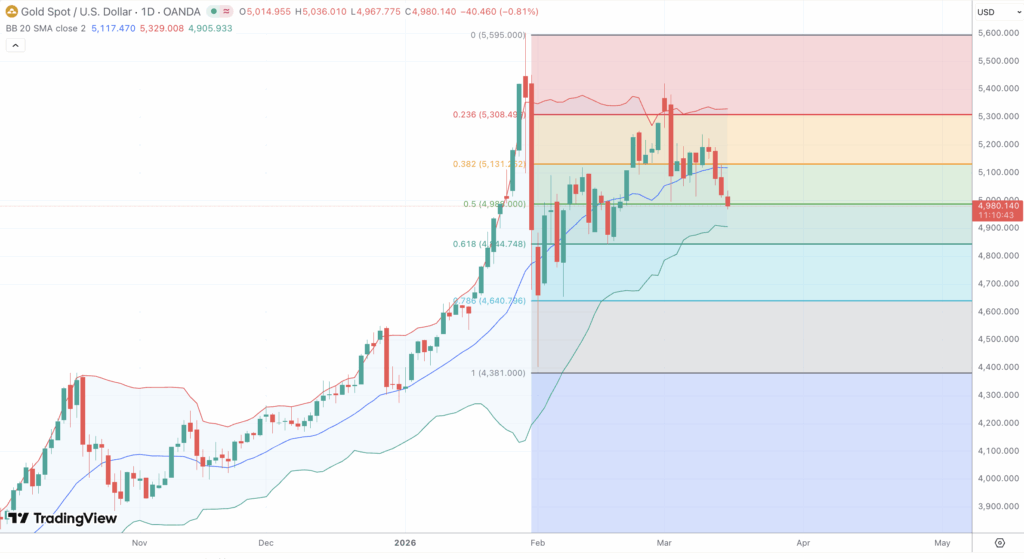
Bollinger Bands show price testing the lower band in the $4,900 to $5,000 zone; a bounce from here targets the middle band near $5,130. OBV has deteriorated noticeably since the $5,420 high, with selling sessions accumulating more volume than buying sessions, signaling institutional distribution. Key support levels sit at $5,052, $4,994, and $4,938. Resistance stacks at $5,108, $5,153, and $5,208, with the $5,200 zone representing a well-defined supply area. A breakout through $5,208 on volume opens the path toward $5,267 and $5,321.
On the fundamental side, the March rate hold is fully priced, but the dot plot tone is the real variable. Nordea’s strategists have flagged the risk of a potential hike if Strait of Hormuz closure fears embed a persistent energy-driven inflation shock. The PCE deflator remains sticky at 2.8%, well above the Fed’s 2% target, while unemployment has ticked to 4.4%, trapping the central bank between its dual mandates. The Trump administration’s universal 10% tariffs, with potential escalation to 15%, add a further systemic risk layer that has historically supported gold. Central bank demand remains a constructive structural backdrop, though official sector buying typically moderates at historically elevated price levels.
Looking Forward
The week sets up as a binary event around Wednesday’s FOMC decision, with the technical framework favoring bears short-term while the secular picture remains intact. A defense of the $5,000 to $5,052 zone would establish a base for recovery toward $5,130 and then $5,200. A break below $4,988 on a daily close, particularly alongside a hawkish dot plot, would expose the 61.8% Fibonacci retracement at $4,845 and the 50-day EMA near $4,945.
The risk asymmetry slightly favors a short-term bounce given the RSI approaching oversold, the Bullish Engulfing at support, and MACD histogram compression. That bounce, however, is capped by event risk. A Powell press conference signaling rates on hold through 2026, or explicitly deferring cuts to 2027, would likely trigger a fresh leg lower. Any hint of dovish flexibility, whether through softened inflation language or acknowledgment of labor market deterioration at 4.4% unemployment, would be read as a green light for a retest of the $5,200 supply zone.
Geopolitical developments remain an asymmetric upside catalyst. Escalation threatening Strait of Hormuz passage could override any negative rate signal from the Fed, while de-escalation would erode the safe-haven premium currently embedded in spot prices. Traders holding long positions through the FOMC decision are managing simultaneous rate and geopolitical risk, an environment that justifies tighter stops and measured positioning.