
Key Takeaways
- Gold trading in a defined range between support at $3,275 and resistance around $3,350.
- Technical indicators bearish short-term: RSI below 50, negative MACD, with moving-average hurdles at $3,330 (50-MA) and $3,325 (200-MA).
- S. inflation remains above target, real yields subdued, and central bank accumulation underpin long-term demand.
- Fed minutes, CPI/PPI data, and tariff developments are the week’s primary catalysts.
- Geopolitical risks and seasonal buying could trigger sharp swings beyond the current range.
Market Dynamics and Recent Performance
Gold opened the week trading around the low-$3,300s, pressured by a stronger U.S. dollar following robust June payroll data and a steady 4.1% unemployment rate. The unexpected resilience in the labor market has tempered expectations for Fed rate cuts this summer, bolstering Treasury yields and diminishing bullion’s appeal as a non-yielding asset. Simultaneously, progress on U.S. trade agreements and an extension of tariff reprieves have eased some safe-haven demand, driving prices briefly below $3,310. Yet intermittent flare-ups in Middle Eastern tensions and talk of additional fiscal stimulus in Washington have prevented a deeper pullback, keeping prices comfortably above key support near $3,275.
Technical and Fundamental Influences
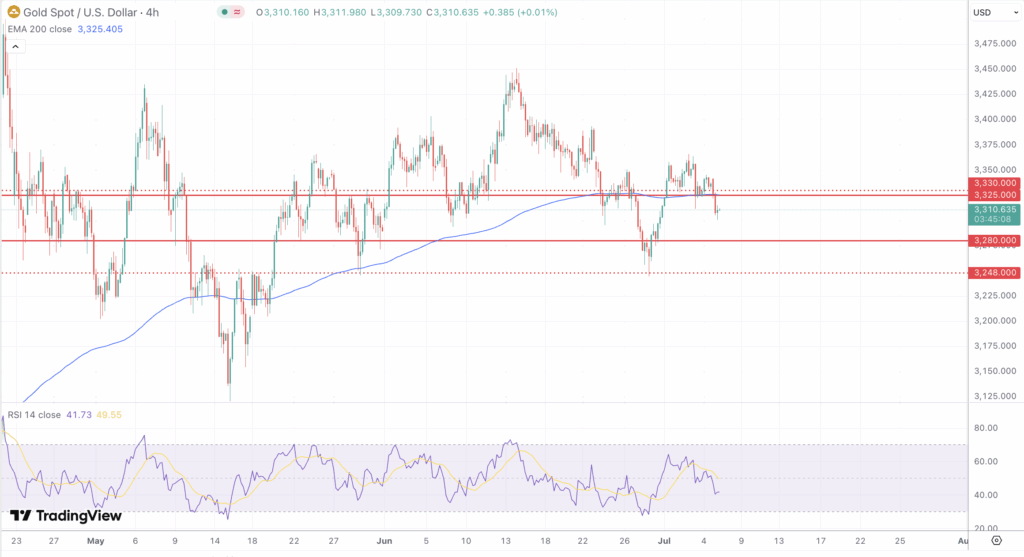
From a chart perspective, gold’s four-hour chart shows resistance aligned with the 50-period moving average at roughly $3,330 and a stronger barrier at its 200-period average near $3,250. Short-term momentum indicators are bearish: the RSI sits around 42 (below its mid-line threshold), while the MACD histogram has dipped into negative territory, hinting that relief rallies may struggle to gather steam. On the downside, immediate support clusters around $3,280, followed by the April low at $3,248. Volume profiles indicate a high-interest node between $3,300–$3,315, suggesting that a sustained break below this zone could accelerate selling toward $3,275.
Fundamentally, gold remains underpinned by subdued real yields and persistent inflationary pressures, with U.S. consumer prices rising 3.1% year-over-year in June. Central bank buying continues to be a significant driver: major emerging-market banks have accumulated over 1,000 tonnes of bullion annually in recent years, providing a steady bid. Meanwhile, market pricing implies only one modest rate cut by the Fed before year-end, keeping rate-sensitive assets in check. On the flip side, U.S. lawmakers’ proposals for multi-trillion-dollar spending packages and ongoing tariff negotiations inject a layer of uncertainty that could lift gold should risk sentiment sour.
Looking Forward
Traders will closely monitor Wednesday’s FOMC minutes for fresh clues on the Fed’s policy trajectory and whether officials are comfortable delaying rate reductions. Later in the week, U.S. CPI and PPI prints will offer further insight into the inflation backdrop and real-rate outlook. The looming August 1 tariff deadline remains a wildcard, any hint of escalation could swiftly drive bullion toward $3,400. Geopolitical developments, particularly oil-related tensions in the Middle East, could also spur safe-haven flows, while seasonal demand in India and China may support prices if importers step back into the market. Overall, gold appears poised to trade within a $3,275–$3,350 corridor unless a major fundamental surprise upends prevailing sentiment.