

Key Takeaways
- Gold rebounded from a two-week low as yields eased and risk hedging picked up, but firmer July PPI keeps the market sensitive to policy repricing.
- The working range is $3,250 to $3,450, with an EMA confluence at $3,353 and a trendline near the low $3,310s acting as support. A daily close above $3,409 would tilt momentum higher.
- The dollar is soft near the high-97s while Treasury yields churn between 4.0 percent and 4.6 percent, a mix that limits directional energy but cushions dips.
- Markets still price a high probability of a 25 bp cut in September, keeping downside contained unless Fed rhetoric turns meaningfully hawkish.
Market Dynamics and Recent Performance
Gold started the new week with a bid after buyers stepped in near the mid-$3,330s, recovering from a two-week low as Treasury yields eased and traders weighed geopolitical headlines. Spot prices were last seen around $3,340 to $3,355, with December futures a touch higher. The bounce has been helped by a softer tone in yields and pre-event positioning ahead of high-level talks on Ukraine as well as the Fed’s late-August policy symposium.
Still, inflation remains the pivot. The July Producer Price Index rose 0.9 percent month on month and 3.3 percent year on year, a hotter-than-expected print that tempered aggressive easing bets and initially pressured non-yielding assets like gold.
Technical and Fundamental Influences
Price action remains inside a well-defined $3,250 to $3,450 band that has contained the market for several sessions. On the 4h chart, spot gold reclaimed short-term moving averages late last week, with the 50-EMA and the 100-EMA around $3,353. Momentum has improved from neutral territory, with RSI in the mid-50s, which suggests room to extend if resistance thins above $3,375 to $3,409. Immediate support sits near $3,346, followed by a rising trendline around the low $3,310s, then the range floor at $3,250.
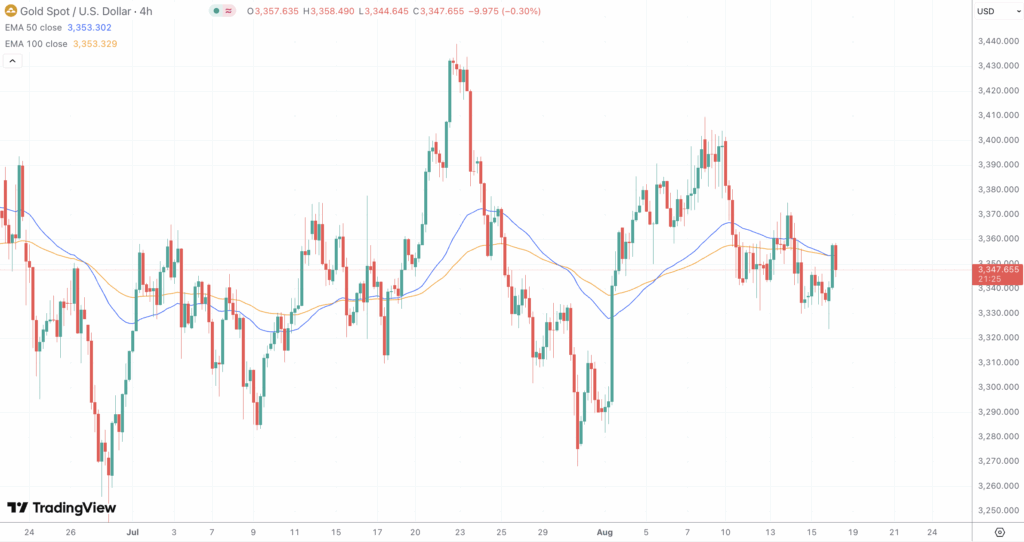
The macro backdrop is mixed but supportive on dips. The US Dollar Index has been sliding toward the high-97s, even as yields consolidate broadly between 4.0 percent and 4.6 percent across the Treasury curve. A softer dollar tends to ease headwinds for bullion, while range-bound yields limit directional conviction.
Policy expectations remain crucial. Fed-funds futures still assign high odds to a 25 bp rate cut at the September meeting, even after the firmer PPI. Market-implied probabilities for a cut have hovered around the mid-80s to low-90s percent area in recent days, which keeps a floor under gold on setbacks.
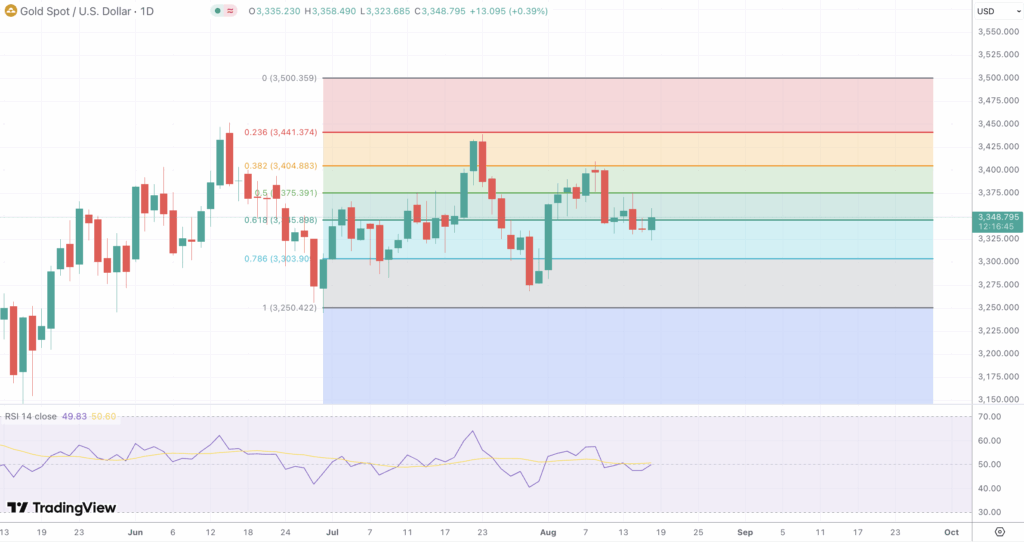
From a pure chart perspective, the current structure shows a balanced consolidation. Using recent swing references, the 61.8 percent retracement of the $3,250 to $3,500 move aligns near $3,345 to $3,350, which overlaps with the 50- and 100-day averages and explains the sticky behavior in this zone. The 38.2 percent retracement comes in around $3,400 to $3,405, close to an intermediate cap that repeatedly stalled rallies. A daily close through that $3,400 to $3,410 pocket would signal a momentum shift and expose the high-$3,4xxs. Levels and behavior around those zones remain consistent with last week’s intraday and daily analyses.
Looking Forward
Two streams will guide the next leg. First, macro signals, with attention on any additional inflation or growth surprises and the tone from Fed speakers into Jackson Hole. Confirmation that a September trim is still the base case, even with sticky wholesale prices, would likely keep dips supported into $3,312 to $3,346. A hawkish pushback or renewed upside in yields would re-test $3,250.
Second, the charts. Bulls need a clean daily close above $3,409 to re-open $3,450 and then the psychological $3,500 area. Failure to clear that band and a slip back below the EMA cluster would hand the initiative to sellers, initially targeting the trendline in the low $3,310s and the range base near $3,250. Volatility around geopolitical headlines could add whipsaws inside the range, so watch intraday rejections at the boundaries for trade execution.