

Key Takeaways
- Spot starts the week around 1.1700 as markets price a high probability of a September Fed cut, leaving the dollar on its back foot.
- Germany’s Ifo rose to 89.0 in August, helping sentiment into Thursday’s euro area confidence data.
- Technicals: RSI ~58, MACD marginally positive, ADX ~27. The 20-day EMA and 50-day SMA cluster near 1.165, with Fibonacci resistance layered at 1.1706 and 1.1736, then 1.1789 and 1.1830.
- First supports: 1.1677, 1.1650, then 1.1600 to 1.1580. A daily close above 1.1740 would unlock 1.1789 and 1.1830.
- Watch Thursday’s US GDP second estimate and Friday’s PCE at 14:30 CEST for the week’s pivotal impulses. Softer PCE likely extends euro strength, while a firmer print would favor a dollar bounce.
Market Dynamics and Recent Performance
The euro opened the week near 1.17 after Friday’s post-Jackson Hole jump, with Monday trade hovering around 1.1700 to 1.1710. The move reflects a softer dollar after Chair Powell leaned dovish, pushing odds of a September Fed cut into the mid-80s and knocking the dollar index lower. German data helped the euro’s tone, with the Ifo business climate rising to 89.0 in August, the best in over a year. This week’s macro focus tilts to the United States, where the Q2 GDP second estimate lands on Thursday and the July PCE inflation report arrives Friday. In Europe, sentiment gauges from the European Commission fill the calendar before next week’s flash HICP.
Technical and Fundamental Influences
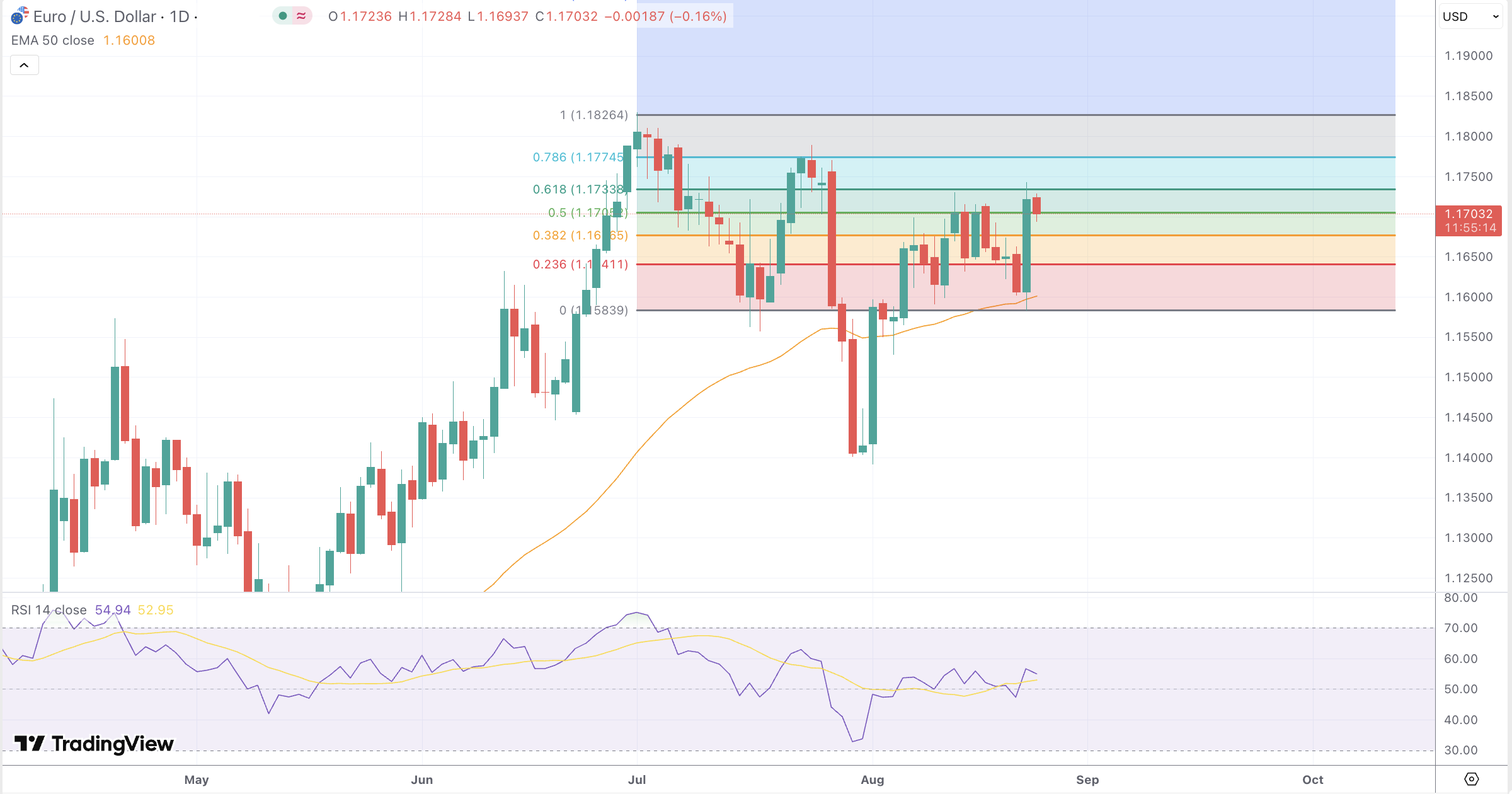
On the daily chart, momentum is constructive without being overextended. RSI sits close to 58, MACD has turned slightly positive, and ADX near 27 suggests trend strength is moderate. Price is riding above clustered moving averages, with the 20-day EMA near 1.1652 and the 50-day SMA close to 1.1651, keeping a supportive shelf just below spot. Short-term gauges are mixed, but the daily setup still skews mildly bullish while price holds that 1.1640 to 1.1660 band.
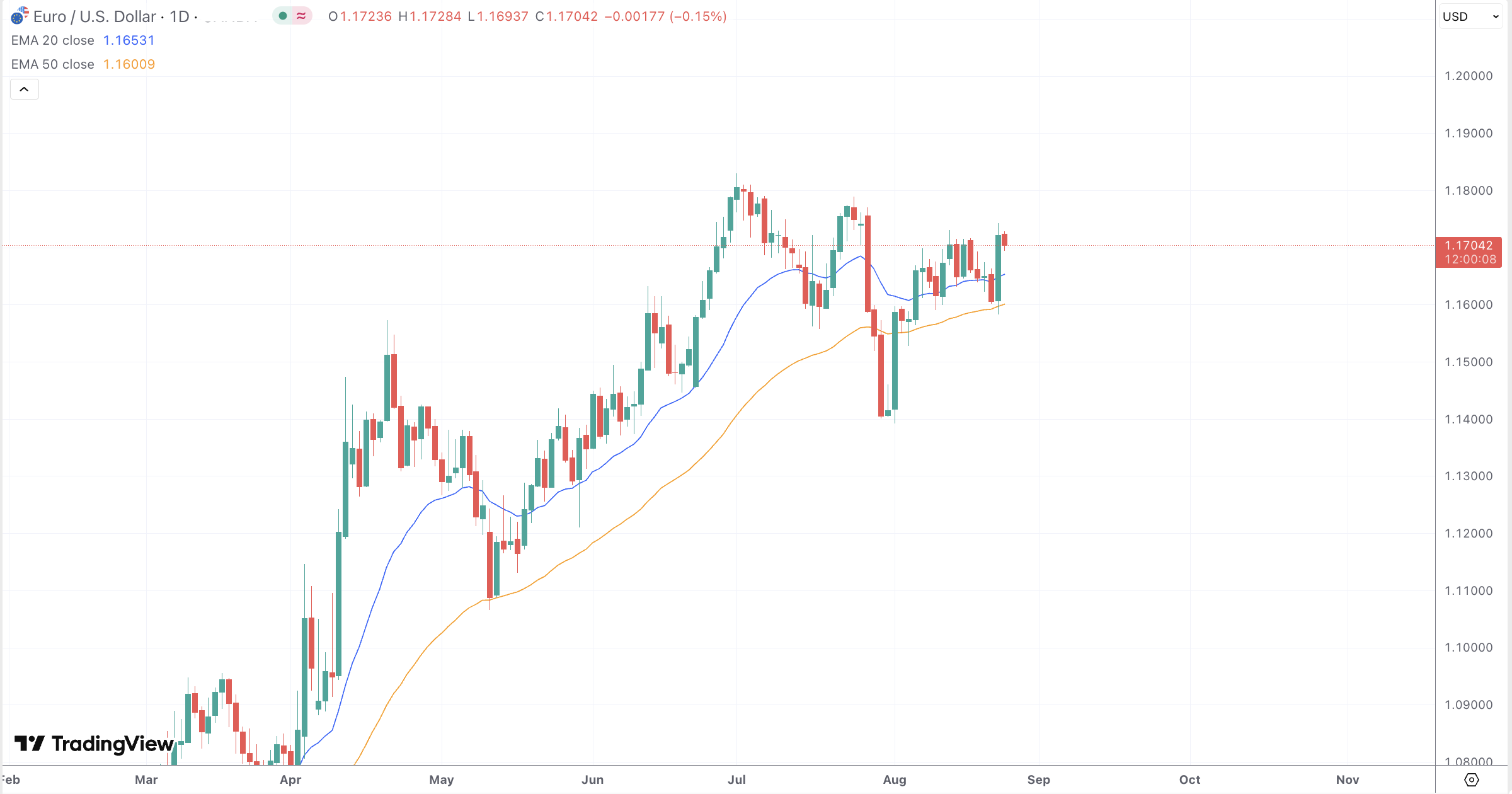
From a price-map perspective, the late-July swing high around 1.1830 and last week’s trough near 1.1583 frame this month’s range. Fibonacci retracements of that move line up as follows: 38.2 percent at 1.1677, 50 percent at 1.1706, and 61.8 percent at 1.1736. That creates a neat confluence around current levels, with the 50 percent line sitting right at spot and the 61.8 percent overlapping a descending trendline near 1.1740. Clear acceptance above 1.1740 would open the door to 1.1789 then 1.1830. Failure back below 1.1677 would risk a slip to the 1.1650 50-day, then 1.1600 and the 1.1580 area.
Positioning is a mild tailwind. Latest IMM data show euro net longs still sizable, while the broader dollar has weakened as markets rotate toward a Fed easing path into year-end. That leaves scope for additional euro upside if US data undercut real yields again, though long euro exposure can amplify pullbacks on upside inflation surprises.
Event risk is front-loaded to the US. The BEA posts the Q2 GDP second estimate on Thursday at 14:30 CEST and July PCE on Friday at 14:30 CEST. Consensus looks for a still-solid growth print and a 0.2 percent month-over-month core PCE. A soft PCE would likely pressure the dollar further and keep EURUSD bid. A firm PCE or upside GDP revision would do the opposite. In the euro area, Thursday’s EC sentiment surveys and money-supply data are watched for confirmation of gradual stabilization following the Ifo beat, but they typically carry less FX punch than PCE.
Looking Forward
The near-term bias is sideways to higher as long as EURUSD holds above 1.1640 to 1.1660. A daily close through 1.1740 would tilt momentum toward 1.1789 and 1.1830, with follow-through favored if RSI pushes into the 60s. Back under 1.1677 would warn that the bounce is fading, exposing the 1.1650 50-day and 1.1600. Volatility over the past week has averaged in the 70 to 80-pip zone, so whipsaw around Thursday and Friday’s 14:30 CEST prints is a reasonable base case. Bigger picture, the ECB remains on hold after mid-year cuts, while US policy expectations are drifting lower. That policy divergence-lite still argues for dip-buying while the dollar stays on the defensive, but the path runs through PCE.