

Key Takeaways
- EUR-USD trades at 1.1642, down 0.76 percent over the past month but maintaining a 7.61 percent year-to-date gain, consolidating below the 20 SMA after sharp correction from September highs
- Technical indicators show RSI around 48 (below neutral 50, suggesting bearish momentum) with price trading below the 20 SMA at 1.1651, confirming near-term corrective pressure
- Key support levels sit at 1.1600, 1.1550-1.1580, and 1.1500, with resistance at 1.1651 (20 SMA), 1.1700, 1.1750-1.1800, and September highs near 1.1900
- The Federal Reserve’s October 28-29 meeting is expected to deliver a 25 basis point rate cut with near-unanimous probability, bringing rates to 3.75-4.00 percent
- French political uncertainty continues as Prime Minister Lecornu faces a Wednesday deadline to form a government, with no-confidence motions already tabled by opposition parties
- The ECB holds its deposit rate at 2.00 percent with no additional cuts expected in 2025, creating a narrowing interest rate differential that theoretically favors euro appreciation
- Fed Chairman Powell’s October 29 press conference will be critical for dollar direction, with any guidance on the pace of future rate cuts likely to trigger EUR-USD volatility
- Bullish breakout above 1.1651 (20 SMA) could target 1.1700-1.1800 and potentially 1.1900, while bearish breakdown below 1.1600 would expose 1.1550 and potentially 1.1500-1.1450
Market Dynamics and Recent Performance
The EUR-USD currency pair trades at 1.1642 as of October 27, 2025, declining 0.76 percent over the past month despite maintaining a robust 7.61 percent year-to-date gain. This divergence between near-term weakness and medium-term strength reflects conflicting forces shaping the world’s most liquid currency pair.
Recent price action shows consolidation following a sharp decline from September’s peak near 1.1900. The pair has corrected significantly, losing momentum as it trades below the 20-period simple moving average at 1.1651, reflecting renewed dollar strength and French political uncertainty.
The ongoing US government shutdown continues creating an informational vacuum, with key data releases delayed indefinitely. Critical central bank meetings this week, including the Federal Reserve on October 28-29 and the ECB on October 30, are expected to inject significant volatility into the pair’s trajectory.
Technical and Fundamental Influences
EUR-USD currently trades at 1.1642, positioned just below the 20-period simple moving average at 1.1651. The recent price action shows the pair consolidating after a significant decline from the September highs near 1.1900, with current levels representing a pullback of approximately 250 pips from the peak.
The Relative Strength Index sits around 48, positioned below the neutral 50 line. This reading suggests bearish momentum has the near-term edge, though the indicator remains above oversold territory, leaving room for potential further downside before technical exhaustion signals emerge. The RSI has been trending lower since the September peak, confirming the corrective phase.
Moving average structure indicates near-term pressure. The 20 SMA at 1.1651 now acts as immediate resistance, with price trading below this key dynamic level. A failure to reclaim the 20 SMA keeps the door open for additional downside testing. On longer daily timeframes, the 50-day, 100-day, and 200-day moving averages remain well below current price levels, confirming the medium-term bullish trend remains intact despite the recent correction.
Key support levels sit at 1.1600 (psychological round number), followed by 1.1550-1.1580 zone where prior consolidation occurred. Below that, the 1.1500 handle represents major support. A break below 1.1500 would suggest deeper correction potential toward 1.1450 and 1.1400 levels.
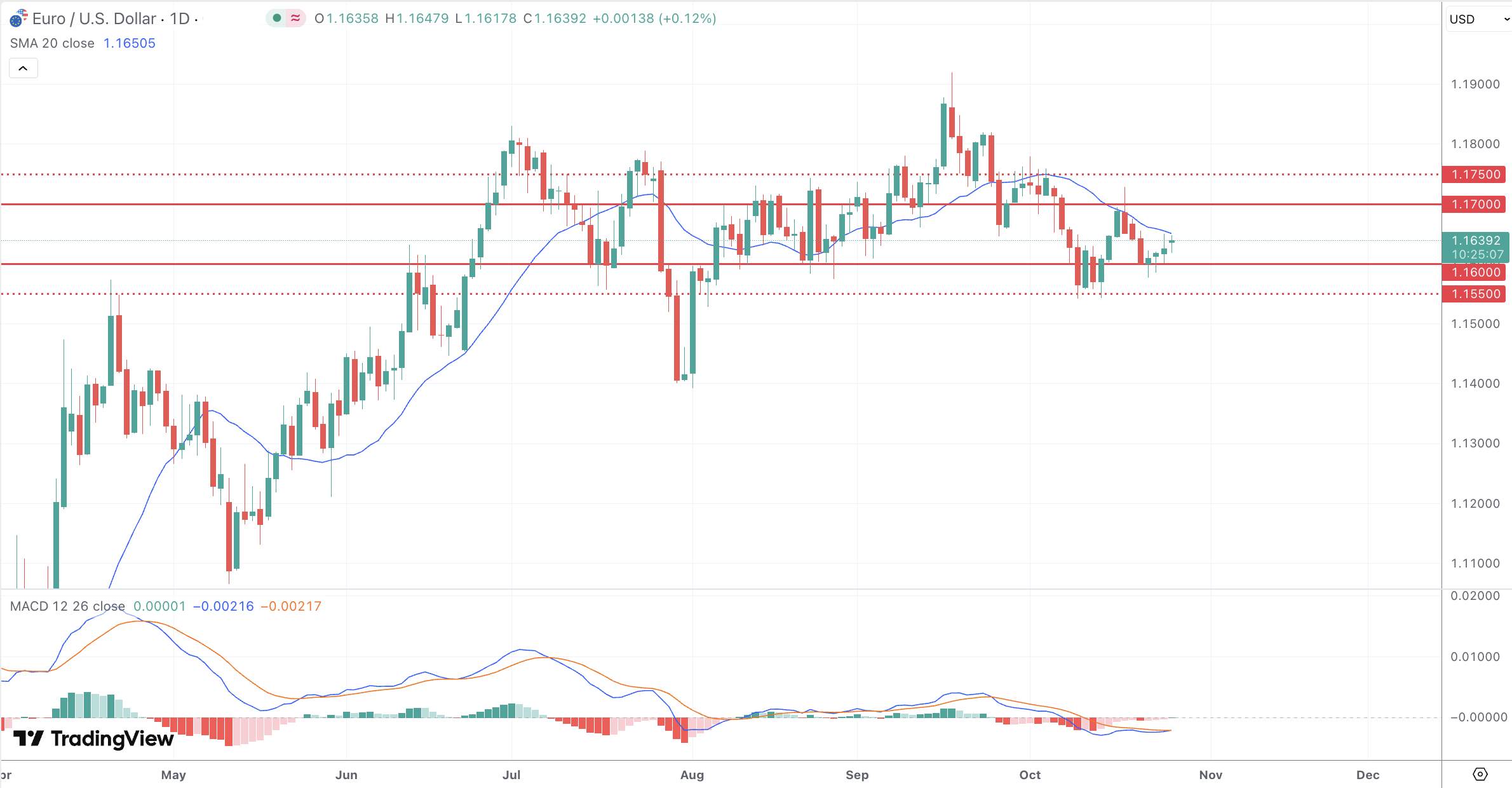
Resistance begins immediately at the 20 SMA near 1.1651, followed by 1.1700 psychological level. Above that, 1.1750-1.1800 represents a significant resistance zone. A sustained recovery above 1.1800 would be required to alleviate the corrective pressure and potentially target a retest of the September highs near 1.1900.
The Federal Reserve’s anticipated 25 basis point rate cut at the October 28-29 meeting brings rates to 3.75-4.00 percent. Markets have priced in 87 percent probability of another December cut. The Fed’s dovish trajectory reduces the dollar’s yield advantage.
The European Central Bank held its deposit rate at 2.00 percent in September, with inflation rising to 2.2 percent. The ECB’s October 30 decision is not expected to deliver additional cuts in 2025, creating a narrowing interest rate differential supporting euro strength.
French Prime Minister Lecornu faces a Wednesday deadline to form a government, with no-confidence motions already tabled. Markets have partially priced in political uncertainty, though persistent instability dampens investor confidence.
Looking Forward
The week ahead carries significant event risk with Fed Chairman Powell’s October 29 press conference representing the focal point for dollar direction, following the FOMC’s anticipated rate decision. Any hints regarding the pace of future easing or economic assessment could trigger substantial volatility in EUR-USD.
In a bullish scenario, EUR-USD recovery above the 20 SMA at 1.1651 would target 1.1700, potentially opening the path toward 1.1750-1.1800 and the September high near 1.1900. The bearish alternative envisions failure to hold 1.1600 support, exposing 1.1550 and potentially triggering declines toward 1.1500 and 1.1450.