

Key Takeaways
- Gold trades at $4,085 after breaking through $4,150-$4,200, maintaining technical strength despite dollar resilience and elevated real yields.
- Federal Reserve rate cut probability has declined from 64% to 53-54% following hawkish FOMC comments, creating uncertainty about December policy decision.
- RSI at 53.8 shows neutral positioning with ample room for upside, MACD shows bullish crossover, and price holds above 50-day moving average at $3,926.
- Key levels: Support at $4,050-$4,070 and $4,000; Resistance at $4,125, $4,150-$4,193, and $4,300. Closes above $4,193 confirm uptrend resumption.
- Multiple Fed speakers this week including Williams, Jefferson, Kashkari, and Waller will provide crucial guidance on December meeting expectations.
- Central bank demand at 1,313 tonnes in Q3 2025 provides structural support as emerging markets continue diversification from dollar reserves.
Market Dynamics and Recent Performance
Spot prices are consolidating between $4,070 and $4,120 after testing the $4,200 barrier earlier in the week. The breakout through $4,150 marked a significant technical trigger, with XAU-USD briefly reaching $4,211 before encountering selling pressure. This represents the strongest weekly performance in nearly a month, with gains exceeding 3.7% at peak levels.
The $4,000 psychological level has proven critical, with each dip attracting fresh buying interest. Gold’s current position at $4,085 places it within striking distance of the key $4,050-$4,070 support zone. Physical demand from Asian markets has moderated due to elevated prices, but central bank accumulation continues providing structural support, particularly from emerging market monetary authorities diversifying away from dollar-denominated assets.
Technical and Fundamental Influences
The 14-day Relative Strength Index currently sits at 53.8, positioned in neutral territory and suggesting ample room for upside movement before reaching overbought levels at 70. This reading indicates neither overbought nor oversold conditions, leaving the door open for price movement in either direction. The MACD indicator shows a bullish crossover with both lines turning upward, reinforcing positive momentum. Price has successfully climbed above the 50-day moving average at $3,926, shifting the intermediate-term bias toward higher levels.
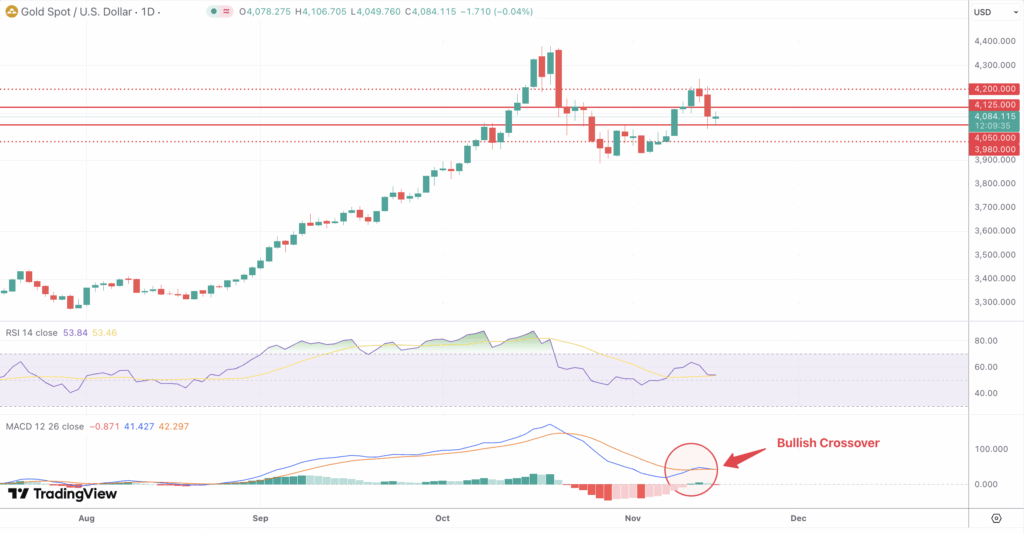
Key resistance levels sit at $4,125 (overnight swing high), $4,150-$4,160 (breakout zone), and $4,193-$4,200 (trend resumption level). A decisive close above $4,193 would open the door toward $4,235-$4,260 and the $4,300 round figure. Support structures are defined at $4,050-$4,070 (first defense), $4,000 (psychological), and $3,975-$3,990 (secondary). A breakdown beneath $4,000 could accelerate losses toward $3,930.
Market pricing for a 25 basis point Fed rate cut in December has fluctuated between 53-64% as officials send conflicting signals. Kansas City Fed President Jeffrey Schmid stated inflation remains “too hot,” contributing to Friday’s 3% intraday selloff. Conversely, Fed Governor Stephen Miran suggested a 50 basis point cut might be appropriate given labor market softness.
October employment showed job losses in government and retail sectors, while consumer sentiment tumbled to three-and-a-half year lows. These developments strengthen the case for easing, though hawkish FOMC commentary has tempered expectations. The Dollar Index holds near 99-100, with real yields above 1% providing modest headwinds that gold has been able to overcome through safe-haven demand.
Central bank purchases reached 1,313 tonnes in Q3 2025 ($146 billion), with China, Poland, and India leading accumulation efforts, creating a durable price floor.
Looking Forward
The week ahead features multiple Fed speakers including Williams, Jefferson, Kashkari, and Waller, whose commentary could significantly shift December rate cut expectations. Markets will scrutinize remarks for clues about the inflation versus employment debate within the committee.
Delayed economic data releases following the government shutdown represent another catalyst. September jobs data and backlogged figures could substantially alter the Fed’s policy calculus, either supporting additional cuts or reinforcing arguments for patience.
With gold currently at $4,085, bulls maintain control as long as prices hold above the crucial $4,050-$4,070 support zone. Any dips toward this area are likely to attract buyers. A clean break above $4,125 followed by $4,193-$4,200 would confirm uptrend resumption and target $4,250-$4,300. Conversely, failure to hold $4,050 raises concerns, with a break below $4,000 potentially accelerating selling toward $3,950-$3,975.
Range-bound trading between $4,000 and $4,200 remains the most likely outcome this week, barring major policy surprises. The path of least resistance appears sideways to slightly higher, with bulls maintaining a marginal edge as long as support holds firm.