

Key Takeaways
- EUR/USD trades around 1.1530, down from September highs near 1.1885, with the November low at 1.1468
- The pair holds below all major moving averages; RSI at 45-46 and negative MACD confirm bearish momentum
- Key support: 1.1500, 1.1470, 1.1450, 1.1400; resistance at 1.1568, 1.1600-1.1629, and 1.1700
- Markets price 67-70% probability of a December Fed rate cut; ECB expected to hold rates steady through year-end
- Critical U.S. data this week: PPI/Retail Sales (Tuesday), Q3 GDP and PCE (Wednesday) will shape Fed expectations
- German economy struggles with contracting manufacturing PMI at 48.4; Eurozone Composite PMI at 52.4
- Thanksgiving liquidity conditions may amplify volatility; range-bound trading between 1.1470-1.1700 expected
The EUR/USD pair enters the final week of November under pressure, trading around the 1.1530 level as the single currency struggles to find upward momentum. After sliding below the key 1.1500 psychological level last week, the pair is on track to close November in negative territory, weighed down by a resilient U.S. Dollar and tepid Eurozone economic data.
Market Dynamics and Recent Performance
EUR/USD is hovering near 1.1530 as of Monday, November 24, 2025, representing a year-to-date gain of approximately 10.5% despite recent weakness. The pair touched a three-month low of 1.1468 earlier in November before mounting a modest recovery, though it remains well below the September highs near 1.1885.
The divergence between U.S. and Eurozone economic performance continues to shape price action. Strong U.S. November PMI data released Friday showed the Composite PMI climbing to 54.8, a four-month high, while Eurozone figures painted a less optimistic picture. Germany’s preliminary Services PMI fell to 52.7 from 54.6, with Manufacturing contracting further to 48.4. The Hamburg Commercial Bank noted that the German economy is “limping towards marginal growth at best in the fourth quarter.”
The extended U.S. government shutdown has created uncertainty, but its resolution could shift focus back to the deteriorating fiscal outlook. Meanwhile, Eurozone inflation confirmed at 2.1% year-over-year in October remains close to the ECB’s 2% target, while core inflation held steady at 2.4%. Consumer Confidence in the bloc weakened to -14.2 in November, missing expectations and reflecting ongoing economic concerns.
Technical and Fundamental Influences
From a technical perspective, EUR/USD maintains a bearish bias. The pair trades below all major moving averages, with the 20-day SMA extending its decline beneath the 50- and 100-day SMAs. The 200-day SMA sits near 1.1650, representing significant overhead resistance.
The 14-day RSI reads around 45-46, recovering from earlier oversold conditions but remaining below the neutral 50 midline. The MACD indicator is in negative territory, confirming bearish momentum, while the 100 SMA below the 200 SMA reinforces the downward bias.
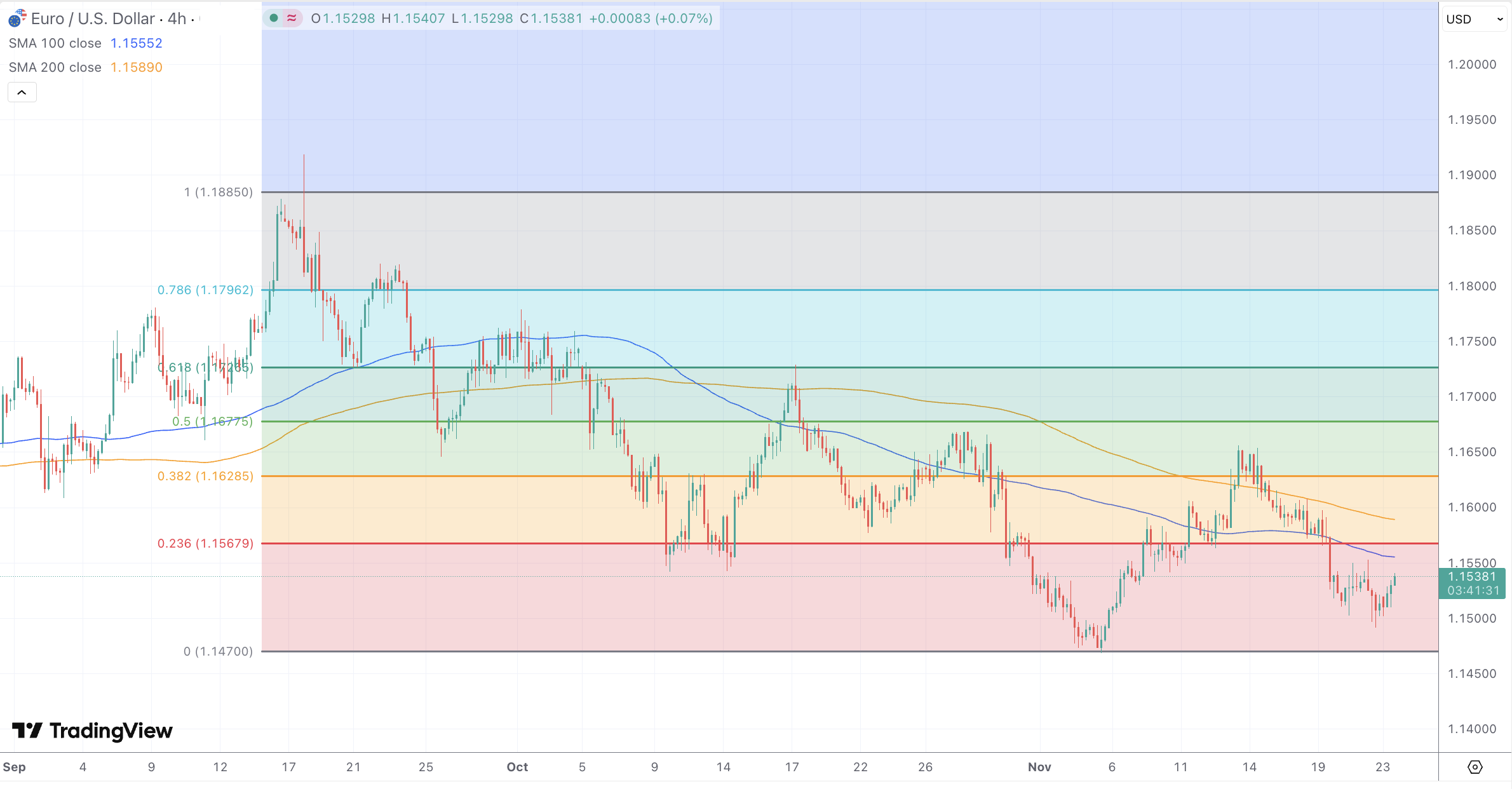
Using Fibonacci retracements measured from the 1.1885 high to the 1.1470 low, key resistance levels emerge at 1.1568 (23.6% retracement), 1.1576-1.1580 (50% retracement), and 1.1602-1.1629 (61.8% retracement). The 1.1600 psychological level coincides with the descending trend line and previous consolidation zones, making it a critical pivot.
On the downside, 1.1500 serves as immediate support, followed by 1.1470 (November low), 1.1450, and the significant 1.1400 horizontal level that has acted as both support and resistance since April. A breakdown below 1.1400 could signal the end of the broader uptrend that began at 1.04 in late 2024.
Fundamentally, markets are pricing approximately 67-70% probability of a Fed rate cut in December after NY Fed President Williams’ dovish comments, up sharply from around 33-40% earlier in the week. However, hawkish Fed minutes and divided FOMC opinion create uncertainty. The ECB, having held rates unchanged at its October meeting with the Deposit Facility at 2.00%, is expected to remain on hold through year-end, with President Lagarde stating monetary policy is “in a good place.”
Looking Forward
This week’s U.S. economic calendar is dense with delayed data releases: PPI and Retail Sales on Tuesday, followed by Q3 GDP and PCE inflation on Wednesday. These figures will be crucial in shaping December Fed expectations and could trigger significant EUR/USD volatility.
Thin liquidity around Thanksgiving on November 27 may amplify price swings in either direction. The pair is expected to remain range-bound between 1.1470 and 1.1700, with choppy conditions likely to persist given the policy uncertainty on both sides of the Atlantic.
For a sustained bullish reversal, EUR/USD would need to reclaim the 1.1800 psychological resistance level. Until then, rallies are likely to be met with renewed selling pressure. Conversely, a decisive break below 1.1400 could expose the pair to further losses toward 1.1260 or lower.
The broader outlook depends heavily on whether the Fed proceeds with a December rate cut and how economic data evolves. An ECB pause combined with Fed easing would typically support EUR/USD, but soft Eurozone growth and political uncertainty in Germany and France continue to cap the euro’s upside potential.