

Key Takeaways
- EUR/USD is trading at 1.1636, firmly below the 200-day SMA at 1.1683, signalling a shift in medium-term momentum toward the bears
- RSI(14) has dropped to 42.41 and has crossed beneath its signal line at 51.33, confirming building selling pressure
- Eurozone headline CPI surged to 3.0% in April from 2.6% in March, driven almost entirely by energy costs tied to ongoing US-Iran tensions
- Money markets assign an 86% probability to a 25bp ECB rate hike at the June 11 meeting, which would lift the deposit rate to 2.25%
- US April PPI came in at 6.0%, the hottest reading in nearly four years, raising the possibility of Fed tightening rather than further easing
- CME derivatives now price a greater than 30% probability of a Federal Reserve rate hike in 2026, rising to 50% by March 2027
- Key support levels this week are 1.1550, followed by the 2026 low at 1.1435; resistance sits at 1.1683 and 1.1800
Market Dynamics and Recent Performance
EUR/USD opened the week at 1.1620, printing a high of 1.1645 and a low of 1.1608 before settling near 1.1636. The pair has retreated sharply from its 2026 peak of 1.2019 set on January 27, and now trades below the 200-day SMA after slicing through that level during the current corrective phase. The broader macro backdrop is defined by a dramatic reversal in rate expectations. The ECB held its deposit facility rate at 2.00% at its April 30 meeting, with the refinancing rate at 2.15% and the marginal lending rate at 2.40%, but Lagarde explicitly left the door open for June, acknowledging that upside risks to inflation and downside risks to growth have intensified simultaneously. Markets swung from pricing no ECB hikes as recently as late March to an 86% probability of a 25bp move on June 11.
On the US side, a 6% April PPI print and core PCE estimates near 3.3% have forced derivatives markets to price in a growing probability of a Fed rate hike, a complete reversal from the two-cut consensus held by Goldman Sachs, Morgan Stanley, and Barclays only months ago. Jerome Powell’s second term ended May 15, adding institutional uncertainty to the dollar’s near-term direction. Geopolitics remain the decisive wildcard: Brent crude has held above $105 following Trump’s rejection of Iran’s latest peace proposal on May 12, pushing eurozone inflation higher while simultaneously undermining regional growth. The IMF trimmed its 2026 eurozone growth forecast to 1.1% from 1.4%, and Germany’s May ZEW sentiment indicator printed at -10.2, still firmly in negative territory despite a seven-point improvement from April.
Technical and Fundamental Influences
The daily chart presents a technically deteriorated setup. Price at 1.1636 has closed beneath the 200-day SMA at 1.1683, shifting the medium-term presumption toward bearish. The RSI(14) at 42.41, with the signal line at 51.33, confirms the crossunder and leaves room for additional downside before oversold conditions near 30 are reached. The MACD complex has been tracking close to its zero line, with the histogram tilting negative alongside the RSI crossunder, reinforcing the corrective bias.
Applying Fibonacci retracement to the 2026 swing structure from the March 15 low at 1.1435 to the January 27 peak at 1.2019, the pair has already cleared the 61.8% retracement near 1.1658. The next Fibonacci floor sits at the 78.6% level around 1.1560, converging with broader chart support. Below that, the 100% retracement returns focus to the 1.1435 cycle low. Recovery targets on the upside are the 50% retracement at 1.1727 and the 38.2% level near 1.1796. Bollinger Bands have widened as volatility expands with the directional decline, while Parabolic SAR dots have flipped above price, confirming the short-term trend and signalling that any bounce will need to reclaim the 200-day SMA to shift momentum. ADX has been rising from subdued levels as the corrective phase intensifies. ATR has expanded with the recent moves, reflecting heightened sensitivity to macro data and geopolitical headlines. OBV has shown declining readings in the recent leg lower, consistent with distribution rather than accumulation.
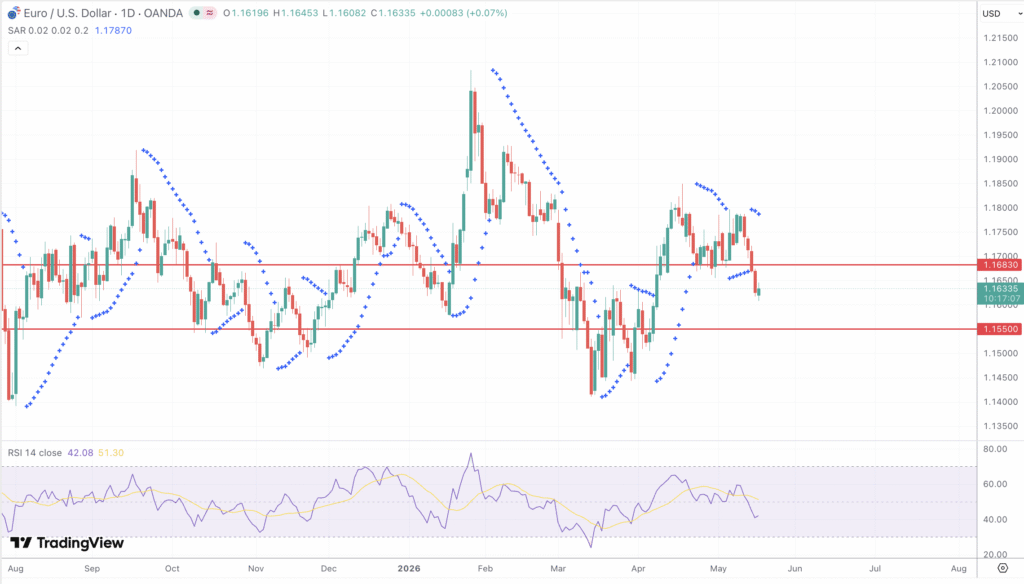
Key levels frame the week clearly. Support at 1.1550 is the first structural floor; a break opens the path to 1.1476 and then 1.1435. Topside resistance begins at the 200-day SMA at 1.1683, extends through the 1.1730-1.1760 distribution zone, and then the critical 1.1800-1.1840 ceiling. Fundamentally, the ECB deposit rate at 2.00% versus a Fed funds upper bound of 3.75% still leaves a wide rate gap, but the direction of travel for each institution has become far less predictable. Eurozone headline inflation at 3.0% in April is energy-driven rather than demand-led, complicating any ECB move: hiking to contain a supply-side price shock risks deepening the growth shortfall in an economy expanding at just 1.1% for 2026. Core inflation at 2.2% provides the ECB with some cover, but Germany’s Q1 GDP of 0.1% quarter-on-quarter underscores the fragility of the bloc’s industrial base.
Looking Forward
The week ahead presents asymmetric risk shaped by the June 11 ECB meeting looming on the horizon, elevated energy prices tied to unresolved US-Iran tensions, and a Federal Reserve whose policy path has shifted from expected easing to possible tightening. Thursday’s eurozone final CPI confirmation is the key data point; an upside surprise would provide the euro with a defensive floor, while any US release printing above consensus would reinforce dollar strength and cap recovery attempts in the 1.1683-1.1730 resistance band. Oil price developments around US-Iran negotiations could override the data calendar entirely, given that a move toward $115 Brent would sharpen stagflationary concerns in the eurozone.
The base case sees EUR/USD trading within a 1.1500-1.1750 range this week with a downside bias while price holds below the 200-day SMA. A confirmed daily close back above 1.1683 would neutralise the immediate bearish signal and open the path toward 1.1800, but that requires either a meaningful softening in US data or tangible de-escalation in the Middle East. The longer-term picture sees EUR/USD averaging in the 1.16-1.19 region through H2 2026, suggesting the year’s uptrend is not broken but is in a corrective phase that may extend before resolving higher. Traders positioning for the June ECB decision face binary event risk in both directions: a hawkish hike could push the pair toward 1.19 within hours, while a surprise hold returns focus to 1.1435.


