

Key Takeaways
- EUR/USD is trading around $1.177, consolidating just below the critical $1.185 resistance cluster after a sharp recovery from March lows near $1.143
- The 14-period RSI reads 60.97, approaching overbought territory without yet triggering a reversal signal, while the signal line holds at 56.29
- The US-Iran ceasefire, set to expire on April 22, remains the single most consequential near-term variable; any breakdown in talks could quickly reverse recent dollar weakness
- ECB policymakers are increasingly aligned around a readiness to raise rates if energy-driven inflation persists, contrasting with a divided Federal Reserve still leaning toward at least one cut in 2026
- Key resistance sits at $1.181 and $1.185–$1.190; support is layered at $1.168, $1.165–$1.169, and then $1.150
Market Dynamics and Recent Performance
The EUR/USD pair enters the week of April 21 holding near $1.177, having completed a recovery of more than 330 pips from the March trough of approximately $1.143. That low marked the pair’s weakest reading in roughly seven months, driven by the geopolitical shock of the US military intervention in Iran and the effective closure of the Strait of Hormuz, which sent Brent crude surging over 35% from pre-war levels. The ensuing safe-haven bid crushed the pair through the first half of March, snapping the steady uptrend from the January base.
The recovery was equally sharp. A confirmed US-Iran ceasefire triggered a broad unwind of safe-haven dollar positioning, sending the Bloomberg Dollar Spot Index erasing its entire 2026 gain in a single session. Iran’s foreign minister confirmed the Strait of Hormuz had reopened to commercial traffic, WTI crude tumbled more than 10%, and the euro posted a 2.7% weekly advance, its strongest in approximately a year, registering a third consecutive weekly close to the upside.
Optimism remains qualified. The ceasefire expires on April 22 and is widely described as fragile, with back-and-forth attacks in the Persian Gulf continuing even during the truce. Gulf Arab and European diplomats caution that a durable agreement may require up to six months. A secondary euro-positive came from Hungary’s pro-European opposition securing a landslide election victory, expected to unlock billions in frozen EU funding. FOMC minutes released last week confirmed officials still anticipate at least one rate cut in 2026 should inflation decline, reinforcing the Fed-easing versus ECB-resolve narrative.
Technical and Fundamental Influences
The daily chart shows a pair that has recaptured meaningful ground but is pressing against congestion that capped multiple rallies earlier in the year. The session high printed at $1.177, open at $1.174, and low at $1.173, illustrating the consolidative character of recent price action.
The RSI at 14 periods reads 60.97, with the signal line at 56.29. The positive spread confirms momentum remains intact, though the oscillator is approaching the 65–70 zone that capped the February rally when the pair reached its year-to-date high near $1.205. The RSI bottomed close to 35 during the March sell-off, and the current reading sits roughly at the midpoint of the recovery arc, suggesting deceleration risk rather than imminent reversal.
The 5-day EMA is crossing higher through the 50-day, a near-term bullish alignment. The 200-day SMA sits near $1.170, a level the pair reclaimed and has since used as a platform. Price trading above all three major moving average benchmarks reinforces the recovery bias, though the distance from the 200-day mean increases mean-reversion risk if catalysts disappoint.
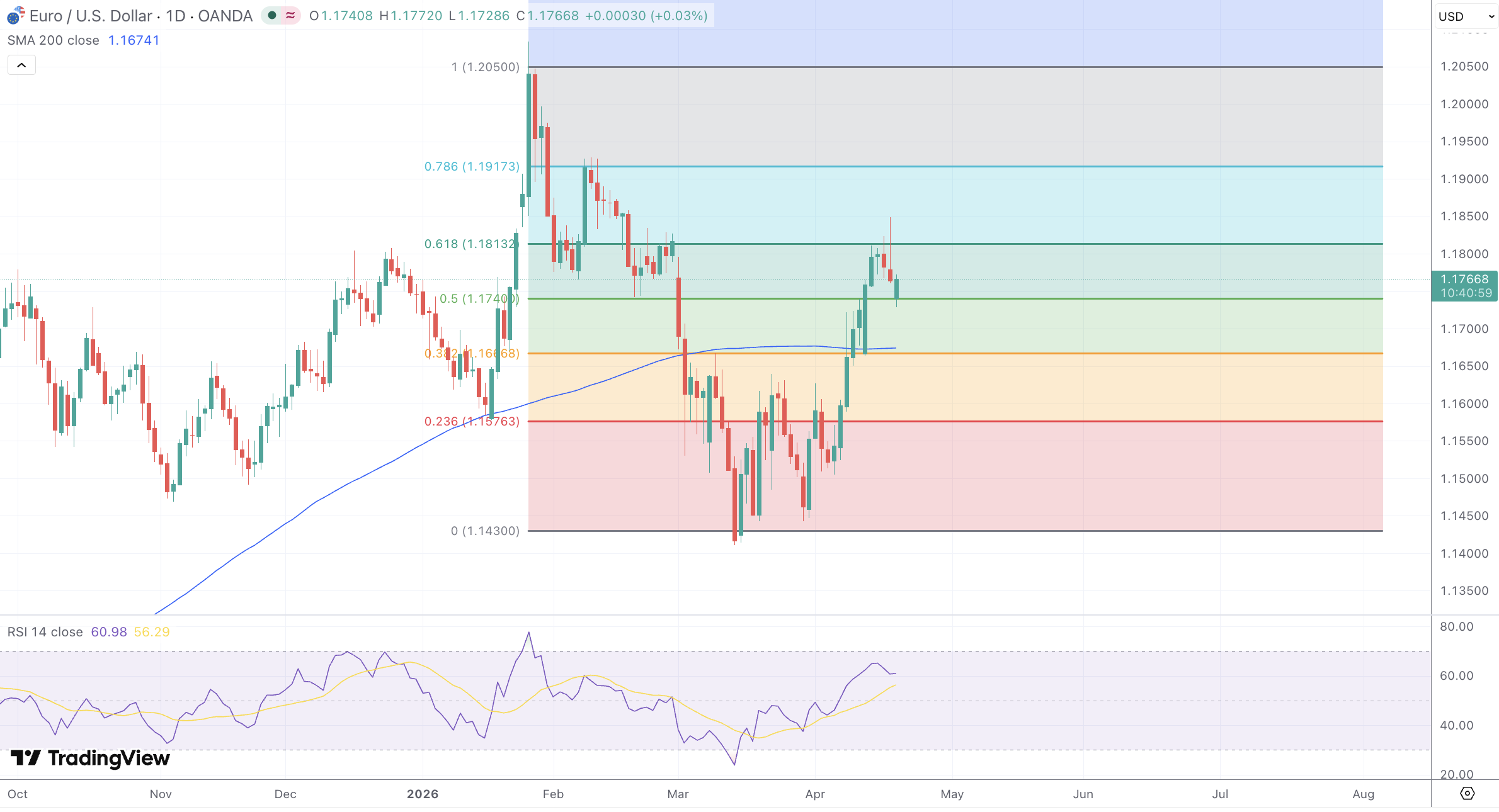
Fibonacci retracement analysis from the February high near $1.205 to the March low of $1.143 places the 61.8% level at roughly $1.181 and the 76.4% retrace near $1.190. The pair currently trades between the 50% level at $1.174 and the 61.8% level, a zone where sellers have historically reasserted on first tests. A daily close above $1.181 opens the path toward $1.190–$1.200. The 38.2% retrace near $1.167 aligns with the $1.165–$1.169 support cluster on the downside. The Parabolic SAR remains below price following the early-April bullish flip; a reversal above price on a close below $1.168 would mark the first SAR-driven bearish signal since the March capitulation.
The ADX reflects a recovering rather than strongly trending market, with +DI above -DI confirming the bullish directional bias without yet exhibiting conviction-level readings. ATR remains elevated relative to pre-war norms, consistent with the headline-driven volatility of the geopolitical period. Bollinger Bands show price in the upper half of the daily range but not pressing the upper boundary, typical of a directional but non-parabolic advance with band width still expanded from the March volatility spike. On-Balance Volume trends positively from the March low, confirming that volume has accompanied the recovery. Upper shadow candlestick formations over the past two sessions near $1.177–$1.185 signal intraday selling pressure at resistance and support the near-term consolidation thesis.
On the fundamental side, the ECB has signalled readiness to hike rates if energy-cost inflation persists, with markets pricing approximately two 25-basis-point increases by year-end. The Federal Reserve has held at 4.00%, with officials split between a cut and an extended hold given the inflationary impulse from oil prices. The roughly 200-basis-point rate differential continues to structurally support the dollar, but the directional tilt favours compression if ECB hawkishness firms while Fed dovishness advances. The final Eurozone HICP estimate, expected to confirm year-on-year inflation near 2.5%, is the primary data event for the euro this week; any upside surprise would further reduce rate-cut probability and add a fresh fundamental tailwind.
Looking Forward
The ceasefire expiry on April 22 is the immediate pivot point. A successful extension would likely drive EUR/USD through the $1.181 Fibonacci resistance toward the $1.185–$1.190 zone. A breakdown in talks would reprice oil higher and reinstate the defensive dollar bid that took the pair to $1.143 in March, with support at $1.168, then $1.165–$1.169, and a more significant floor at $1.150.
The April 30 ECB meeting is the next major central bank catalyst. Any explicit shift toward rate-hike language beyond Lagarde’s current data-dependent stance would add a new structural layer to euro support. This week also marks what is expected to be Jerome Powell’s final FOMC meeting as chair; the transition to his as-yet-unconfirmed successor Kevin Warsh adds a modest additional layer of USD uncertainty.
The primary scenario favours consolidation in the $1.168–$1.185 range pending ceasefire and central bank clarity. A weekly close above $1.185 would constitute a breakout signal targeting $1.200, consistent with Wells Fargo’s Q2 projection at $1.190 and ING’s fair-value estimate approaching $1.200 through the second half of the year. The bear case, tied to geopolitical re-escalation or a hot US inflation print, would press the pair back toward $1.165 and potentially $1.150, though a re-test of the March lows near $1.143 would require a materially more adverse combination of outcomes than current pricing reflects.