

Key Takeaways
- EUR/USD trades at 1.1742 after Friday’s daily session, posting an open of 1.1699, a high of 1.1747, a low of 1.1699 and a close of 1.1742, finishing 0.21% higher.
- Price is wedged between the 38.2% Fibonacci retracement at 1.1698 and the 50% midpoint at 1.1775 of the February high at 1.2100 to March low at 1.1450 swing.
- Daily RSI 14 reads 56.34 with its smoothing line at 58.91, indicating moderate bullish momentum without overbought stretching above the 70 threshold.
- The MACD 12 26 9 line at 0.00323 sits above its signal line at 0.00312, producing a fresh positive histogram print of 0.00011 that confirms an early bullish crossover.
- Twin central bank events dominate the week, with the FOMC on Wednesday April 29 priced at roughly 94 to 99.5% odds of a hold at 3.75 to 4.00%, and the ECB on Thursday April 30 carrying around 91% odds of a hold at 2.00%, with a 26% tail risk of a 25 basis point hike to 2.25%.
- Iran related geopolitical headlines, oil price action and Islamabad shuttle diplomacy retain the capacity to override scheduled data flow.
- Speculative weekly range sits between 1.1610 and 1.1790, with extension toward 1.1840 to 1.1850 on a hawkish ECB outcome and downside risk toward 1.1500 on a Fed driven dollar squeeze.
Market Dynamics and Recent Performance
The euro entered the final week of April attempting to rebuild its footing above the 1.1700 handle after slipping to two week lows in the prior fortnight. Friday’s daily candle closed at 1.1742, up 0.21% on the session, with the bar carving out a high of 1.1747 against an intraday low of 1.1699. The pair had ended a three week winning streak earlier in April when renewed dollar strength surfaced amid heightened Middle East uncertainty, yet bulls have so far defended the 1.1500 to 1.1530 zone that capped March’s selloff and produced the swing low close to 1.1450. Renewed optimism around US Iran shuttle diplomacy, with the Iranian Foreign Minister expected to arrive in Islamabad as Pakistan brokers a tentative dialogue channel, has cushioned euro losses and tempered safe haven dollar demand into the weekend.
The broader macro backdrop remains conflicted. Eurozone private sector activity contracted at the fastest pace since November 2024 as energy driven cost pressures filtered through services and manufacturing, while Germany’s IFO Current Assessment Index fell to 85.4 in April from 86.7 in March, undercutting any euro tailwind from rate divergence narratives. Germany’s Economics Ministry has halved its 2026 GDP growth forecast, citing the energy shock from sustained Middle East tensions, with Brent crude having traded above 103 dollars per barrel earlier in the month. On the US side, the dollar index has held in the 98 region, anchored by relatively elevated 10 year Treasury yields around 4.3% versus comparable Bund yields close to 3.4%. That 90 basis point yield differential continues to support capital flows toward dollar denominated assets, even as money markets begin pricing a more hawkish ECB profile heading into June, where hike probability has climbed to roughly 80%.
Technical and Fundamental Influences
Technically, EUR/USD is consolidating inside a broader corrective range between the February swing high at 1.2100 and the March swing low at 1.1450. The full retracement structure of that 650 pip downswing maps the 23.6% Fibonacci at 1.1604, the 38.2% at 1.1698, the 50% midpoint at 1.1775, the 61.8% golden ratio at 1.1852 and the 78.6% deep retracement at 1.1961. Current price at 1.1742 is therefore caught above the 38.2% level and below the 50% midpoint, defining the immediate decision zone where directional bias will be resolved.
The daily RSI 14 reads 56.34 with its smoothed companion at 58.91, showing moderate positive momentum without stretching into overbought territory. The indicator has been climbing steadily off the late March print near 25, which marked deep oversold conditions during the slide to 1.1450. The MACD 12 26 9 configuration prints the MACD line at 0.00323 marginally above the signal at 0.00312, with a positive histogram of 0.00011 confirming a fresh bullish crossover after April’s earlier deceleration. Both histogram bars and the MACD curve have shifted into positive territory after dwelling below zero through most of March, marking a notable momentum regime change.
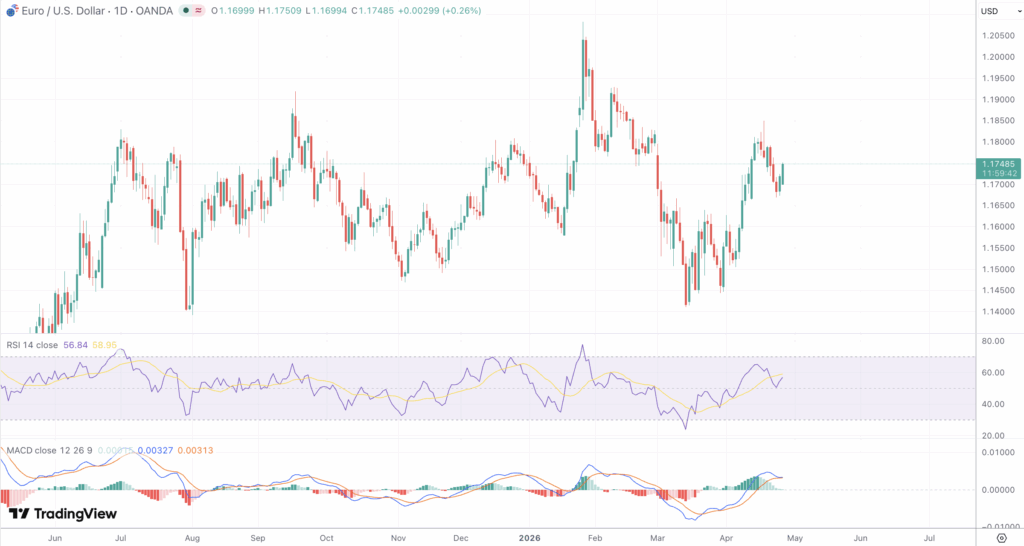
The moving average complex carries weight as dynamic support and resistance. The 5 day EMA tracks near 1.1715, the 20 day SMA hovers around 1.1690, the 50 day SMA aligns close to 1.1675, the 100 day SMA sits near 1.1700 and the 200 day SMA stretches around 1.1715, producing a tightly clustered support belt between 1.1675 and 1.1715 directly underneath spot price. ADX readings hovering in the 18 to 22 range suggest a directionless regime, consistent with the higher lows pattern that has emerged off the March base. Daily ATR has compressed toward 65 to 80 pips, indicating reduced realised volatility ahead of the policy events. Bollinger Bands on the daily chart have contracted into a narrower envelope through mid April, with price oscillating around the 20 day middle band near 1.1690 and the upper band capping rallies toward 1.1810. OBV has tilted modestly higher through April, hinting at quiet accumulation under the surface, and candlestick structure produced a hammer style print near 1.1665 last week that aligned with the 100 period 4 hour SMA confluence, further reinforcing dip buying interest at 1.1670.
Fundamentally, the rate differential remains the central anchor. The Federal Reserve sits at 3.75 to 4.00% with markets pricing a 94 to 99.5% probability of a hold at the April 29 FOMC, and the policy stance has been described as roughly neutral rather than overtly restrictive. The ECB holds the deposit facility at 2.00%, with a 91% probability of an unchanged decision on April 30 and a 26% probability of a 25 basis point hike that would lift the deposit rate to 2.25%. Money markets fully price two quarter point ECB increases through 2026, with hike odds climbing to roughly 80% by the June meeting and a third move pencilled in for late summer by some investment banks. The ECB’s March projections lifted 2026 headline inflation forecasts to 2.6% while cutting 2026 GDP growth to 0.9%, reflecting the stagflationary tilt facing Frankfurt’s policymakers. On the US side, the most recent CPI print at 3.3% keeps the Fed sidelined, while Powell has flagged that monthly nonfarm payroll figures may be overstating job creation by roughly 60,000 per month, signalling greater reliance on broader labour aggregates and unemployment claims trends.
Looking Forward
The week ahead is structurally pivotal for EUR/USD. The FOMC statement on Wednesday April 29 followed by the ECB decision on Thursday April 30 forms a 24 hour window capable of generating 100 to 200 pip swings as the rate differential narrative is recalibrated. A confirmed dovish drift in the Fed statement combined with even modestly hawkish ECB language flagging June action would push the pair into a test of the 1.1775 50% Fibonacci level and likely on toward the 1.1840 to 1.1850 zone, where the 61.8% retracement and recent April highs converge. A clean break above 1.1850 unlocks the 1.1920 to 1.1950 region and ultimately the 1.2000 psychological barrier. Wells Fargo currently anchors a Q2 2026 forecast around 1.19, ING holds a 1.20 fair value with a 1.21 Q4 target, and Deutsche Bank carries a 1.25 end 2026 outlook, lending fundamental support to dip buying strategies in this consolidation.
A more hawkish Fed posture, an ECB that under delivers relative to the hawkish tail, or a renewed geopolitical escalation could pressure EUR/USD back through 1.1700 and toward 1.1656 to 1.1669, where prior resistance has flipped into support. A loss of 1.1610 would expose the 1.1542 to 1.1550 zone, and a deeper unwind toward the 1.1500 psychological floor and ultimately the March swing low at 1.1450 cannot be ruled out if oil spikes again on a Strait of Hormuz disruption. The optimal accumulation pocket on dips remains the 1.1685 to 1.1705 region, with risk tightly defined under 1.1650 and upside structured around a sustained reclaim of 1.1840.
For the week, the base case speculative range is anchored between 1.1610 and 1.1790, extending to 1.1840 to 1.1850 on a hawkish ECB surprise and toward the 1.1500 to 1.1530 demand zone on a Fed driven dollar squeeze. Position sizing should respect the compressed pre FOMC implied volatility, which is likely to expand sharply through Wednesday and Thursday, and traders should remain alert to headlines from Islamabad and the Strait of Hormuz that retain the capacity to override scheduled data and central bank guidance. The medium term bias still leans constructively for the euro provided the 1.1500 base holds, but only a decisive close above 1.1850 will confirm the resumption of the broader uptrend that originated from the 1.0400 lows of last year.


