

Key Takeaways
- Current Position: EUR/USD trades around 1.1520 after declining 1.47% monthly, showing bearish momentum near key support
- Technical Outlook: Bearish signals with RSI at 35 approaching oversold, moving averages showing strong sell, sellers in control
- Fed Policy Impact: Hawkish 25-bp cut to 3.75-4.00% with December cut now highly uncertain, supporting dollar strength
- ECB Stance: Deposit rate held at 2.00%, balanced inflation outlook, political uncertainty in France and Germany weighing on euro
- Support Levels: Critical support at 1.1500, followed by 1.1420 and 1.1300 if psychological level breaks
- Resistance Zones: Former support at 1.1570-1.1536 now resistance, followed by 1.1620 and 1.1660-1.1670
- Monthly Forecast: November trading expected between 1.1310-1.1890 range, current momentum suggests lower end more likely
Market Dynamics and Recent Performance
EUR/USD currently trades around 1.1520, showing continued weakness after declining 1.47% over the past month. Despite posting a 6.13% gain over twelve months, the pair faces mounting pressure as policy divergence between the Federal Reserve and European Central Bank intensifies. Recent sessions reveal bearish momentum building, with the pair breaking below key support levels and struggling near the lower end of its recent range.
The currency pair produced highs around 1.1732 on October 17 before retreating sharply to current levels. Trading activity reveals increased selling pressure following both Fed and ECB meetings, with neither central bank providing supportive guidance. Financial institutions remain cautious about higher values as the Federal Reserve maintains its hawkish stance and European political uncertainty weighs on sentiment.
Technical and Fundamental Influences
Technical indicators signal increasing bearish momentum. The Relative Strength Index currently sits at 35, indicating potential bearish pressure and approaching oversold territory. This RSI positioning below 40 suggests sellers maintain control, though the pair is nearing levels where technical rebounds could materialize. The pair trades well below the 20-period Simple Moving Average, confirming short-term weakness.
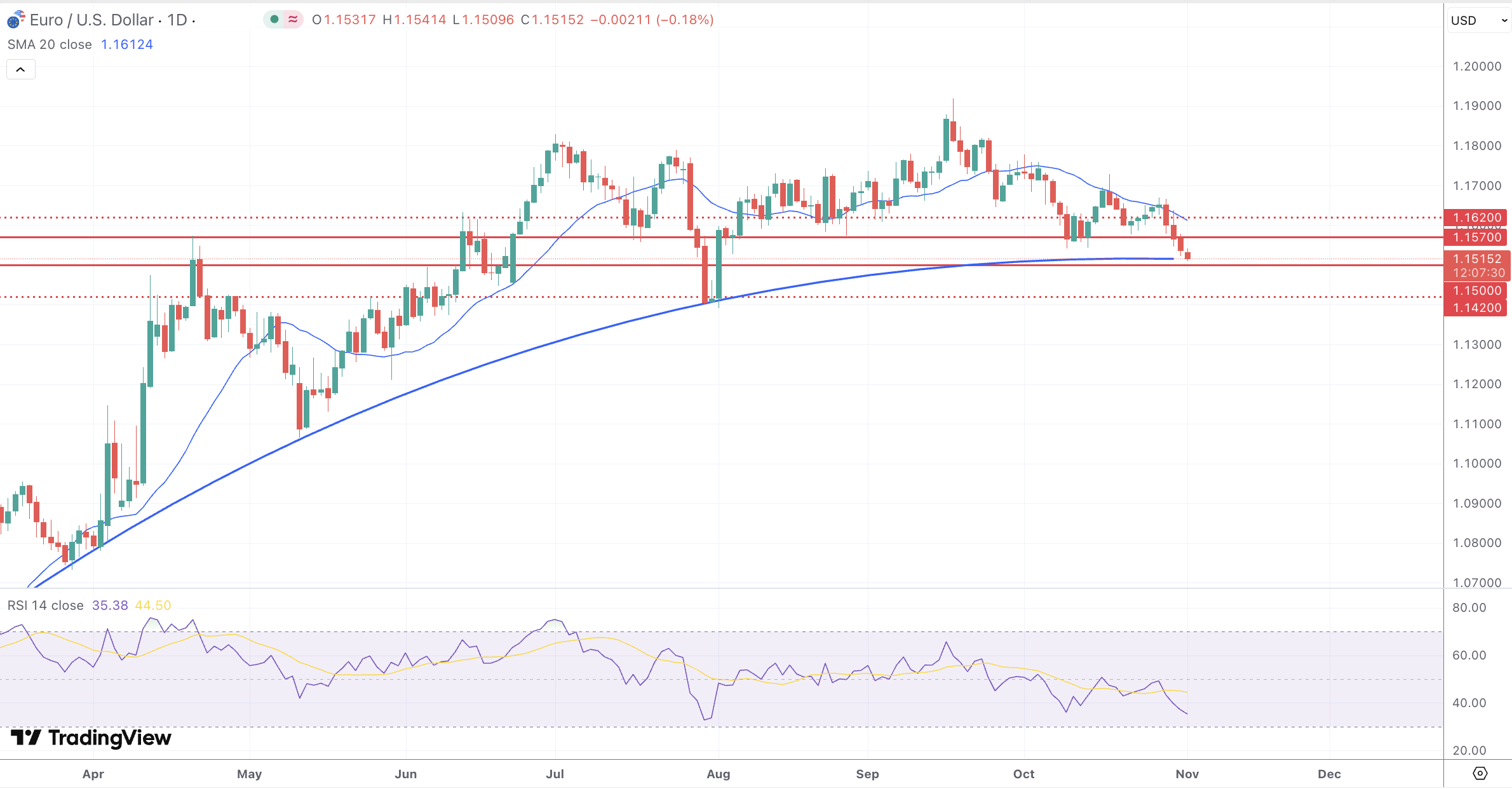
Key resistance levels are established at 1.1570-1.1536, 1.1620, and 1.1660-1.1670, with the former support zone now acting as immediate resistance. A recovery above 1.1570 would be needed to neutralize bearish momentum. Critical support zones include the psychologically important 1.1500 level, followed by 1.1420 and 1.1300. The pair closed below both the 100-day and 20-day SMAs, confirming technical deterioration. A decisive break below 1.1500 could trigger accelerated selling toward 1.1420 or 1.1300.
The Federal Reserve executed a 25-basis-point rate cut in October to 3.75-4.00%, but Fed Chair Powell’s hawkish commentary significantly tempered expectations, stating a December cut is “not a foregone conclusion.” This unexpected caution injected uncertainty as strong FOMC divisions became apparent. The dollar strengthened on these hawkish signals, pressuring EUR/USD lower.
The European Central Bank maintained all rates unchanged with the deposit facility at 2.00%. ECB President Christine Lagarde emphasized policy is “in a good place” with balanced inflation risks. Staff projections see headline inflation averaging 2.1% in 2025. The ECB’s data-dependent approach and reluctance to signal further cuts has limited euro support, while political instability in France and Germany adds to downside pressure.
US-China trade developments provided only temporary relief. The historic agreement includes tariff reductions beginning November 10, with China cutting tariffs to 10% and the US to 30%. However, this de-escalation has failed to generate sustained euro strength, as underlying tensions remain and the one-year duration leaves uncertainty.
Looking Forward
The week ahead faces limited high-tier data releases due to the US government shutdown, suggesting continued uncertainty-driven trading. Federal Reserve communications toward December will prove crucial, as any dovish shift could trigger rebounds while continued hawkishness would extend losses. The pair’s technical position near oversold levels suggests potential for short-term bounces, though the overall bearish structure remains intact.
Key support at 1.1500 will be closely watched. A break below this psychological level could trigger stop-loss orders and accelerate declines toward 1.1420 or 1.1300. Conversely, a rebound above 1.1570 would be needed to neutralize immediate bearish pressure and open the door to recovery toward 1.1620.
For November, analyst consensus projects trading between 1.1310 and 1.1890, though current momentum suggests the lower end of this range is more likely. Month-end targets cluster around 1.1350-1.1620, representing potential further downside from current levels. The interplay between Fed policy expectations and dollar strength will determine whether EUR/USD stabilizes or extends its decline toward the 1.1300 zone.