

Key Takeaways
- BTC/USD closed the prior week at $75,267, posting a daily gain of +1.95%, with the session printing an open of $73,834, a high of $75,590, and a low of $73,753
- The RSI(14) reads 59.08 against its signal line at 60.25, positioning momentum in the upper neutral band just below the threshold that has historically preceded sustained breakouts
- Spot Bitcoin ETFs recorded approximately $1 billion in weekly inflows in the most recent full trading week, with BlackRock’s IBIT alone drawing $284 million in a single session on April 17
- The 200-day moving average has been declining since late March 2026, confirming long-term structural pressure, while the 50-day moving average remains below current price and is rising
- Macro headwinds persist in the form of ongoing US tariff escalation and elevated real yields; a decisive close above $77,500 is required to shift the near-term technical picture materially bullish
- Primary support sits in the $73,000 to $74,000 band, while upside resistance clusters between $77,500 and $80,000
Market Dynamics and Recent Performance
Bitcoin enters the week of April 21 trading around $75,267, representing a recovery of roughly 15% from the cycle low near $63,000 recorded in early February. That trough arrived in the aftermath of the April 2, 2026 tariff announcement, when sweeping import levies triggered near-instantaneous liquidation across risk assets and leveraged positions were force-closed en masse. The episode confirmed what has become a defining characteristic of this macro cycle: Bitcoin’s sensitivity to trade policy shifts is now comparable in speed and magnitude to its historical sensitivity to Federal Reserve rate decisions.
Since that February low, price has traced a sequence of higher lows on the daily timeframe, and candle structure through late March and early April has transitioned from erratic whipsaw bars to progressively tighter bodies, a pattern consistent with institutional accumulation. Cumulative spot ETF inflows have crossed $65 billion since inception, with Q1 2026 alone contributing $18.7 billion during a period when Bitcoin was actually falling in price. That counter-trend conviction has meaningfully altered the supply-demand calculus. The full week ending April 17 saw combined ETF inflows approach $1 billion, the strongest seven-day clip since mid-January. The Crypto Fear and Greed Index nonetheless remained in Fear territory at a reading of 27, and CME open interest is well below Q4 2025 peaks, suggesting the recovery is not yet leveraged in a fragile way.
Technical and Fundamental Influences
The RSI(14) reads 59.08 with its signal line at 60.25, meaning the fast line has not yet crossed above its average, a momentum confirmation trigger that remains pending. Prior RSI swing highs coincided with price peaks near $79,000 and $75,500 in March and early April, making the 60-level a credible near-term inflection zone. The 5-day EMA has crossed above the 50-day EMA, and the 50-day is trending upward from roughly $70,500, providing dynamic support below spot. The 200-day SMA has been declining since March 21 and resides near $85,000, placing Bitcoin in a structural condition chartists would classify as a bear market rally until that overhead line is reclaimed.
Fibonacci retracement of the $126,000 October 2025 high to the $63,000 February low places the 25% level at $78,750, the 38.2% level at $84,500, and the 50% level at $94,500. Current price sits below even the shallowest retracement, illustrating how much ground remains before the corrective structure resolves. Horizontal resistance sits at $77,500 with a secondary cluster near $80,000, while support is layered between $73,000 and $74,000, tested and held three times since early April. The next major floor below is $70,000 to $71,000. ATR is running near $2,100, reflecting moderate transitional volatility.
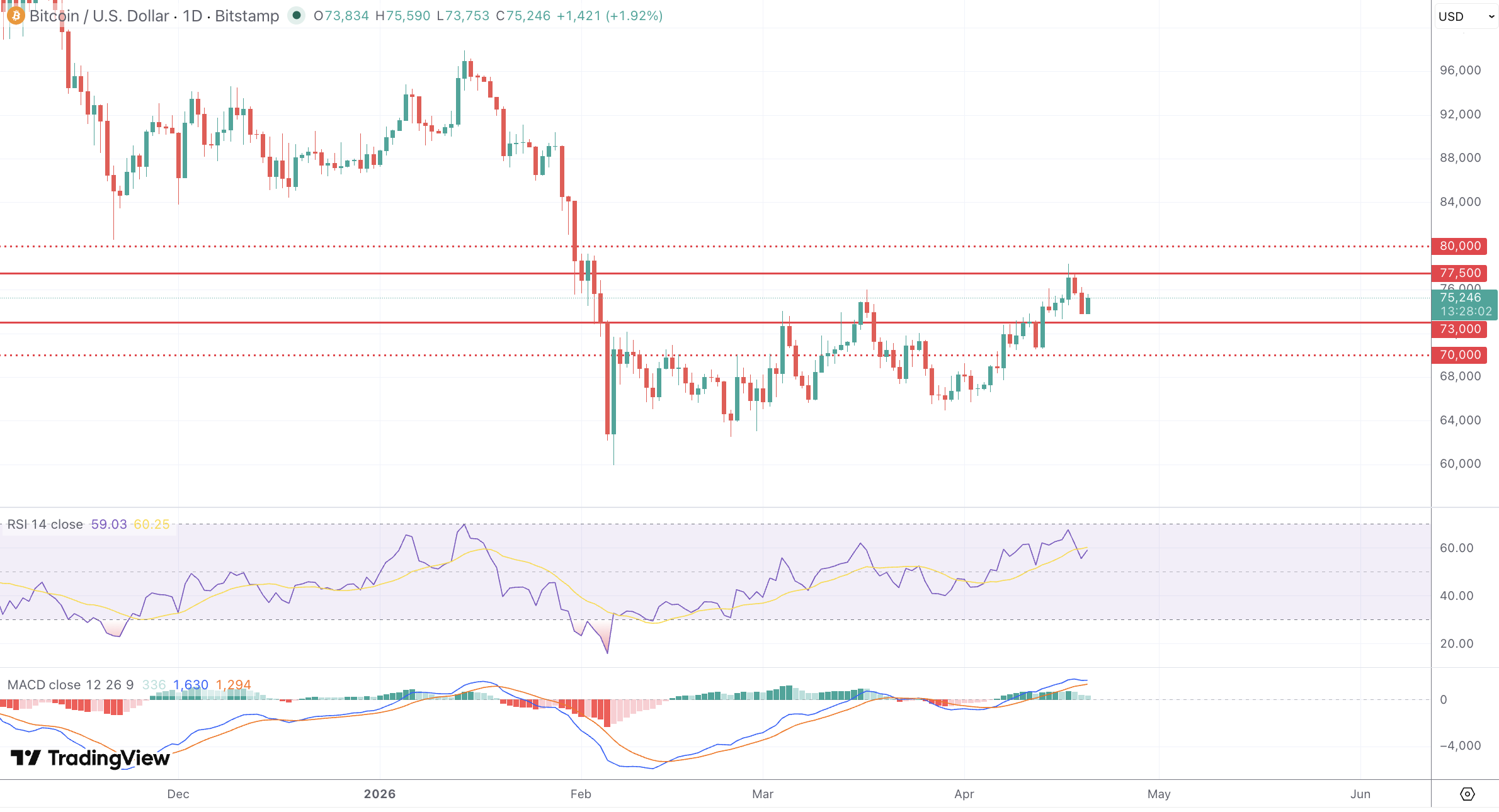
Bollinger Band width has contracted over the past ten sessions as price compresses between $73,500 and $76,500, a setup that frequently precedes directional expansion, with price in the upper half of the band favoring an initial upside resolution. OBV has trended higher since February, confirming accumulation. The MACD histogram is printing marginally positive bars above zero, though the signal line gap has narrowed considerably. ADX sits in the mid-20s with +DI holding above -DI, and Parabolic SAR dots remain below price, both consistent with a developing but unconfirmed uptrend.
On the fundamental side, the institutional ETF bid is the primary constructive driver, with IBIT approaching $100 billion in assets under management and MicroStrategy’s treasury exceeding 300,000 BTC. Against this, the Federal Reserve has acknowledged that tariff-driven goods inflation complicates rate normalization, and each tariff escalation since April 2025 has repriced cut expectations lower. The US dollar index has declined approximately 11% from pre-tariff levels over the past twelve months, a development that historically provides a medium-term tailwind for Bitcoin as the de-dollarization narrative attracts capital.
Looking Forward
The week ahead will be defined by the $77,500 resistance level and RSI behavior at the 60.25 signal line. A daily close above $77,500 with RSI clearing its signal and volume at least 20% above the 20-session average would constitute a technically valid breakout, opening initial targets at $80,000 and then $84,500. The base case is continued range-bound action between $73,000 and $77,500, supported by Bollinger Band compression, a neutral ADX, and a stalling RSI. The $74,000 level is the critical line for bulls to defend; a daily close below it reopens a retest of $71,000.
The bearish scenario centers on tariff escalation, a hawkish Fed surprise, or three or more consecutive sessions of ETF net outflows, any of which would challenge $70,000 and extend downside toward $67,000 to $68,000. With Fear and Greed anchored in Fear territory and the 200-day SMA declining overhead, the risk-reward calculus favors patience until the $77,500 breakout confirms or a deeper flush creates a higher-conviction long entry.


